What Is a Marketing Funnel? A Simple Full Funnel Strategy Guide
December 08 , 2025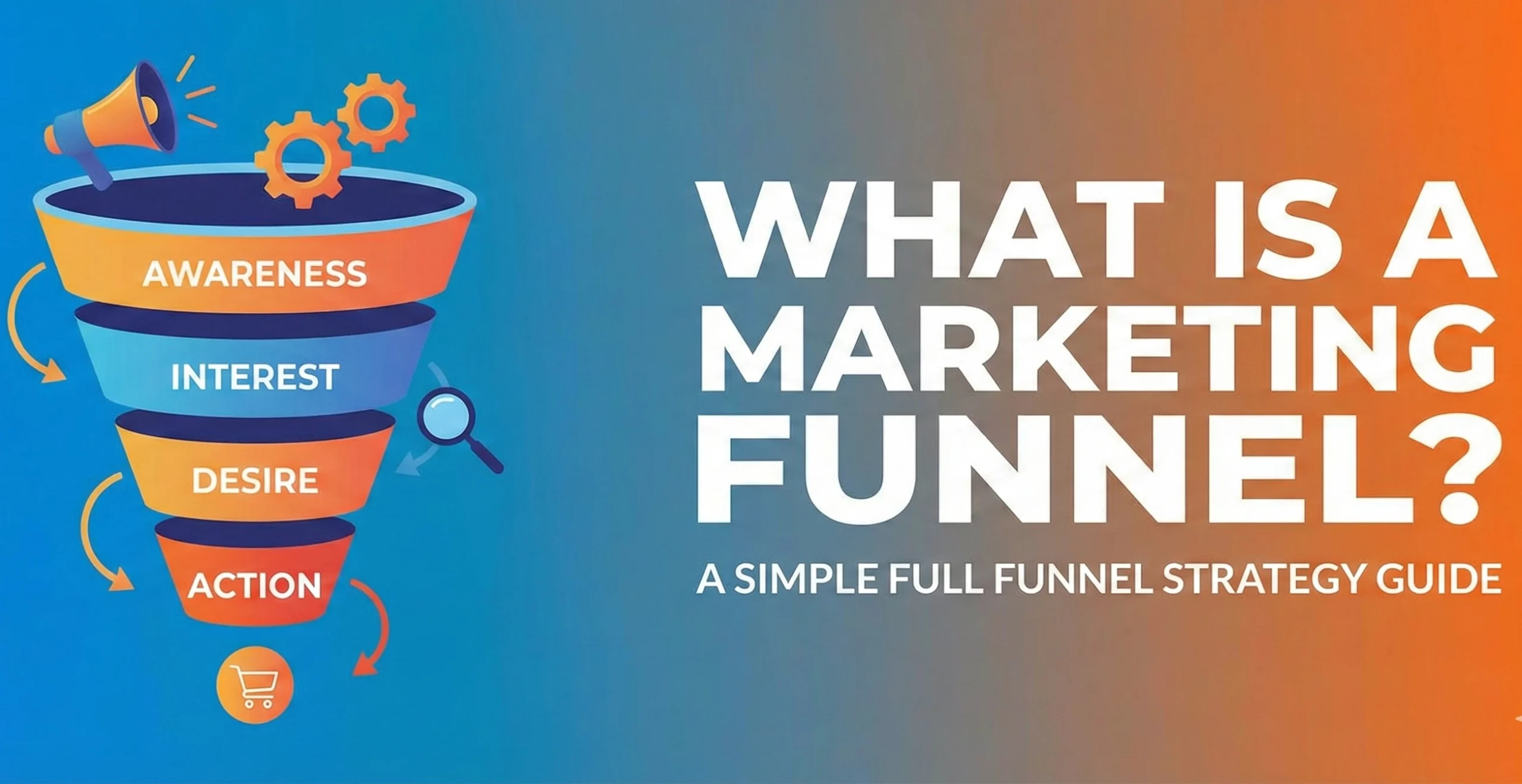
John stares at his analytics dashboard. Again.
His website gets decent traffic. Last month, 2,000 people visited. That should be good news.
But here’s the problem: only 3 of them bought anything.
He paid Google to send him traffic. He got it. But where did everyone go? One minute they’re reading his homepage. The next minute they’re gone.
John feels confused. He scrolled through some marketing blogs and kept seeing one term: “marketing funnel.” “Just build a funnel,” everyone says. “Your conversions will skyrocket.”
But John has no idea what that actually means.
Does he need to hire someone? Is it expensive? Is it complicated? And most importantly — will it actually work?
He’s not alone. Thousands of small business owners stare at the same problem every single day.
A Business Owner With a Sales Problem
John’s situation is typical for small business owners across the USA.
He runs a digital marketing services company. He gets traffic from Google Ads and organic search. But traffic doesn’t equal sales. John doesn’t understand where the breakdown happens.
Does people leave because the landing page is bad? Are they interested but never hear from him again? Are they comparing him to competitors? John has no system to answer these questions.
Without answers, he keeps throwing money at ads. More traffic comes. But conversion rates stay the same — or worse.
The feeling is frustrating. He’s doing something, but it feels random. There’s no structure. No plan. Just hope and guessing.
Then someone mentions “marketing funnel” and says it changed everything for their business.
John finally asks the obvious question: “But what actually IS a marketing funnel?”
Marketing Funnel Explained in Simple Words
Let’s start simple.
A marketing funnel is the customer journey. It shows how a stranger becomes a buyer. Think of it like a path with steps. Each step moves the customer closer to a purchase.
Here’s the simplest way to think about it:
A marketing funnel is a step-by-step sales system that guides people from “I don’t know about you” to “I bought from you.”
It answers these questions:
- How do people find out about my business?
- Why would they care?
- What makes them trust me?
- How do I actually sell to them?
- How do I keep them coming back?
Without a funnel, marketing feels random. You run ads and hope. You post content and cross your fingers. You might get sales, but you can’t repeat the process because you don’t understand what actually works.
With a funnel, every step has a purpose. You know what to do at each stage. You can test, measure, and improve.
Search intent covered:
- What is a marketing funnel?
- Marketing funnel meaning
- Sales funnel for small business
Why a Funnel Is Important for Your Business
Let’s be real. Building a funnel takes effort.
But not building one costs more.
Without a funnel, marketing feels random. You spend money on ads. You post on social media. You hope something sticks. But there’s no system connecting the dots.
With a funnel, every step has a purpose. You waste less money on ads that don’t convert. You get better leads because you know what to look for. You close more sales because you have a proven process. You grow in a controlled way instead of hoping and praying.
Why this matters for different businesses:
A local service business (plumber, electrician) needs a funnel to turn website visitors into phone calls.
An e-commerce store needs a funnel to guide browsers into buyers and then into repeat customers.
A SaaS company needs a funnel to convert free trial users into paying subscribers.
A real estate agent needs a funnel to nurture leads over months until they’re ready to sell or buy.
Every business type benefits because every business has the same core problem: customers don’t move forward automatically. They need guidance at each step.
The Full Marketing Funnel Stages (Simple)
A marketing funnel has 5 main stages. Each one has one clear goal.
Stage 1: Awareness
Goal: Let people know you exist.
This is where people first hear about your business. They see your Google Ad. They find your blog post in search results. They see your post on Facebook. They stumble on your website.
What works here:
- Google Ads
- Facebook Ads
- SEO (organic search)
- Social media posts
- YouTube
- Podcasts
Stage 2: Interest
Goal: Make people care about your solution.
Now they know you exist. But why should they care? At this stage, you give them information. You show them why their problem matters. You introduce your solution.
What works here:
- Blog posts
- Videos
- Educational guides
- Email sequences
- Webinars
- Free tools
Stage 3: Consideration
Goal: Build trust so they believe in you.
People are interested. But they’re scared. What if they waste money? What if your service is bad? At this stage, you build credibility. You show proof.
What works here:
- Case studies
- Customer reviews and testimonials
- Free trials
- Live webinars with Q&A
- Comparison guides
- Money-back guarantees
Stage 4: Conversion
Goal: Get the sale.
Decision time. The person is ready. Now you need to make it easy for them to buy.
What works here:
- Special offers or discounts
- Simple checkout process
- Sales calls
- Clear pricing pages
- Limited-time offers
- Guarantees
Stage 5: Retention
Goal: Keep the customer and sell again.
Most businesses forget this stage. But keeping a customer is cheaper than finding a new one. This is where you make them happy so they come back.
What works here:
- Email follow-ups
- Loyalty rewards
- Support and customer service
- Upsells (selling more to existing customers)
- Content that helps them succeed
- Community and belonging
Simple Full Funnel Strategy That Works
Here’s the step-by-step approach that actually works for small businesses.
Step 1: Bring Traffic
You can’t sell to people who don’t know you exist.
What to do: Run ads OR build SEO. Or both.
Why: You need people at the top of the funnel.
Tools: Google Ads, Facebook Ads, SEO (organic), LinkedIn.
Real example: A plumber spends $200/month on Google Ads for “emergency plumber near me.” Gets 100 clicks. 80 people land on the website.
Result: 100 new people know about you this month.
Step 2: Capture Leads
Traffic isn’t enough. You need to capture information so you can follow up.
What to do: Create a landing page with an opt-in form. Offer something free (guide, checklist, free trial).
Why: A visitor who leaves is gone forever. A lead you can email is a second (and third, and tenth) chance to sell.
Tools: Leadpages, Unbounce, ConvertKit, Mailchimp.
Real example: The plumber offers a free “10-Point Home Plumbing Checklist” in exchange for an email. 8 of those 100 visitors opt in.
⚠️ Warning: Do not skip lead capture. Without it, you’re throwing away 95% of your traffic. You get one chance to turn a visitor into a lead. Use it.
Result: Out of 100 visitors, 10 give you their email.
Step 3: Nurture Leads
Most people aren’t ready to buy on the first visit. They need time and information.
What to do: Send regular emails. Share helpful content. Answer questions. Build trust.
Why: Leads that get nurtured convert at 3–5x higher rates than cold leads.
Tools: Email marketing (Mailchimp, ConvertKit, ActiveCampaign), CRM (HubSpot free), automation.
Real example: The plumber sends 3 helpful emails over 2 weeks about common plumbing problems, signs of plumbing trouble, and cost of repairs. By week 3, 4 of the 10 leads are ready to talk.
Result: Out of 10 leads, 4 become genuinely interested.
Step 4: Convert Sales
Now it’s time to sell.
What to do: Have a sales conversation. Make a clear offer. Make it easy to buy.
Why: After nurturing, people are ready. Don’t blow it with a confusing checkout or unclear pricing.
Tools: Calendly (scheduling), Stripe (payment), simple landing pages.
Real example: The plumber offers a free in-home inspection (no obligation). 1 of the 4 interested leads books. During the inspection, he finds a problem and suggests a $1,200 repair.
⚠️ Warning: Do not sell on the first visit. Build trust first. The plumber didn’t pitch repair services in his first email. He educated first. That’s why the inspection turned into a sale.
Result: Out of 4 interested leads, 1 buys from you.
Step 5: Retain Customers
The journey doesn’t end at the sale. This is where you multiply your income.
What to do: Keep them happy. Ask for feedback. Sell them more. Ask for referrals.
Why: A customer who buys twice gives you 2x revenue. A customer who refers gives you free customers.
Tools: Email, SMS, customer portals, loyalty programs.
Real example: The plumber sends a follow-up 2 weeks after the repair asking if everything is working. Then he sends seasonal maintenance reminders. That customer books another $800 service 6 months later and refers a friend.
Result: That 1 customer buys twice, refers a friend, leaves a 5-star review.
The full math: 100 visitors → 10 leads → 4 interested → 1 customer → 2 sales from same customer → 1 referral. That’s how small numbers scale.
How Paid Ads and SEO Work Together in a Funnel
Most business owners think they have to choose: ads or SEO. That’s wrong.
Paid ads = fast traffic. When you run Google or Facebook ads, traffic comes immediately. You can test what works. You get data quickly.
SEO = long-term traffic. When you write good content and optimize for search, traffic builds over months. But once it works, it’s free and keeps coming.
Both feed the same funnel. Ads bring you fast results so you can test your funnel quickly. If your conversion rate is bad, ads will show you immediately. You fix it.
SEO brings steady, long-term traffic. By the time SEO kicks in (3–6 months), you’ve already improved your funnel using ads.
Ads bring testing data. SEO brings stable growth. The funnel connects them both.
Smart businesses run both. They use ads to build proof of concept. Then they use SEO to scale without ongoing ad costs.
Big Funnel Mistakes That Kill Sales
Most small business owners make the same mistakes.
Mistake 1: Only running ads. They spend money on traffic but don’t capture leads. People see the ad, click, look around, and leave. No follow-up system exists.
Mistake 2: No email follow-up. They get leads but never send them anything. A lead who doesn’t hear from you for a week? That lead is cold. They’ll buy from someone else.
Mistake 3: No trust content. They ask for the sale without building credibility first. “Buy from me” doesn’t work without proof that you’re trustworthy.
Mistake 4: Poor landing pages. Their ad sends traffic to the homepage. The homepage is for brand. A landing page is for conversion. Different things. Different designs. Different goals.
Mistake 5: No retargeting. When someone visits and leaves, they’re gone. Retargeting shows them ads again on other websites, reminding them about you.
Mistake 6: No repeat sales system. They make a sale and focus only on new customers. Existing customers are the easiest to sell to. Ignore them, and they go to competitors.
A Simple Real-Life Marketing Funnel Example
Let’s make this real.
Example: A Local Gym
Stage 1 (Awareness): A person searches “gym near me” on Google. The gym shows up in Google Ads and Google Maps. The person clicks.
Stage 2 (Interest): The gym’s website shows classes, pricing, and member testimonials. The person reads about how the gym helped people lose weight and get healthy.
Stage 3 (Consideration): The gym offers a free 7-day trial. The person signs up. They come in, try a class, see the facility, meet the trainers.
Stage 4 (Conversion): After the trial, they offer a special price if the person joins within 24 hours. The person is convinced and signs up for a 3-month membership.
Stage 5 (Retention): The gym sends weekly workout tips via email. They celebrate member progress. They offer a friend referral bonus. Members stay longer and refer friends.
The result: One search leads to one customer. That customer stays 18 months and refers 2 friends. One customer becomes 3.
Best Funnel Tools for Small Businesses
You don’t need expensive tools. Good news.
For Ads:
- Google Ads (free to start, pay for clicks)
- Facebook Ads (free to set up, pay for reach)
- Cost: $100–$1,000+ per month
For Landing Pages:
- Leadpages ($25/month)
- Unbounce ($50/month)
- Wix or Squarespace (free or $5–$15/month)
For Email:
- Mailchimp (free for up to 500 contacts)
- Brevo ($20/month for advanced)
- ConvertKit ($25/month for creators)
For CRM (tracking leads):
- HubSpot free CRM (forever free)
- Pipedrive ($15/month)
- Zoho ($12/month)
For Retargeting:
- Facebook Pixel (free, built into Facebook Ads)
- Google Ads Remarketing (free, built into Google Ads)
For Analytics (measuring results):
- Google Analytics (free)
- Facebook Analytics (free)
Simple starter stack: Google Ads + Mailchimp + HubSpot free + Google Analytics. Total cost: $0 (ads are separate). You have everything you need.
How Much a Marketing Funnel Costs
This is where most businesses get confused.
A funnel doesn’t cost money. It doesn’t require a subscription. It’s a system you build.
But implementing a funnel costs something.
Free Funnel Setup:
- Use free tools (Mailchimp, HubSpot free CRM, Google Analytics, Wix)
- Create content yourself (blogs, emails)
- Run organic social media
- Cost: $0 per month, 10–15 hours per week of your time
Low-Budget Funnel:
- Run $200/month in ads
- Use $50/month tools (Leadpages, ConvertKit)
- Spend some time on content
- Cost: $250/month
Advanced Funnel:
- Run $1,000–$5,000/month in ads
- Use premium tools ($100–$300/month combined)
- Hire someone to manage it
- Cost: $1,500–$8,000+ per month
ROI Logic (simple math): If a customer is worth $500 to you, and you spend $100 to acquire them, that’s a 5x return. That’s good.
If you spend $250 on your funnel but gain 3 customers worth $500 each, you earned $1,500 from a $250 investment.
That’s why funnels work. They make your spending efficient.
Marketing Funnel vs Sales Funnel (Simple Difference)
People use these terms interchangeably. But there’s a difference.
Marketing funnel = traffic + leads + interest. This is about getting people’s attention and building interest. It’s about awareness, education, and trust.
Sales funnel = closing deals. This is about actually selling. It’s about demos, proposals, negotiations, and closing.
Full funnel = both together. A complete funnel includes marketing (bringing people in and building trust) and sales (actually closing deals). You need both.
Most small businesses are missing marketing. They jump straight to sales. They show up and ask for money without building trust first. That doesn’t work.
The secret: marketing softens them up. Sales closes them down.
Final Truth About Marketing Funnels
Here’s what most people miss.
A funnel is not a tool. It’s not software you buy. It’s not a template you download.
A funnel is a system.
It’s the system that guides people from “I don’t know you exist” to “I want to buy from you” to “I’ll buy from you again.”
Without a system, growth is slow. It’s random. You get lucky sometimes, then unlucky other times. Your business feels unstable.
With a funnel, sales become predictable. You know how many leads you need to get one customer. You know how much to spend on ads. You know what to expect next month.
Every business in the USA needs one today. Not tomorrow. Today.
The businesses winning right now aren’t the ones with the most money. They’re the ones with the best systems.
Your competitors might already have a funnel. The question is: will you?
Ready to build your funnel and stop wasting money on traffic that doesn’t convert?
Discover how our digital marketing services help small businesses build high-converting funnels that actually generate predictable sales. See why reasons your website isn’t converting leads disappear when you have the right system.
The path is clear. The system works. Now it’s time to build it.
Your first customer is waiting on the other end of a good funnel. Go find them.
Popular Post
What Are The 7 Cs of Social Media Marketing?
The 7 Cs of Social Media Marketing are Content, Community, Conversation, Connection, Consistency, Credibility, and...
Google Removed FAQ Rich Results, But FAQs Still Help AI Find and Cite Your Website
Short Answer: Yes, FAQs Still Matter More Than Ever Google removed FAQ rich results. A...

How Social Proof and Trust Signals improves Conversion Rate
Social proof and trust signals work. Full stop. Products with just 5 reviews sell 270%...
