What Is Search Intent and Why It Matters for AI Visibility
January 13 , 2026
Search intent is the reason someone searched. It’s that simple.
If your page doesn’t match why they searched, AI won’t show it. Period.
Here’s the thing: Google AI ranks answers now, not pages. That means your whole strategy flips. You either match what someone actually wants, or you disappear. There’s no middle ground anymore.
This guide walks you through:
- What search intent actually is (not keyword matching)
- The micro intents that drive real behavior
- How AI reads what people really need
- How to align your content with each intent type
- What you should do right now
What is Search Intent (The Real Definition)
Search intent answers one question: What does the user want right now?
Not what keyword they typed. Not what you’re selling. But what problem they’re trying to solve in that exact moment.
Think about it. Someone searching “how to reduce bounce rate” doesn’t want to buy analytics software. They want to understand why visitors leave. That’s their actual goal. Miss that, and no amount of SEO work saves you.
Why Search Intent Matters More Now Than Ever
The old SEO playbook looked like this: match keywords, build backlinks, rank pages.
Then everything changed.
AI doesn’t care about keywords anymore. It cares about meaning. It predicts what people actually need next. It shows the best answer, not the most optimized page.
Here’s what that means for you. A page with perfect backlinks and exact-match keywords gets ignored if it doesn’t answer the intent. Meanwhile, a newer page that perfectly matches what the user wants? It wins. That’s just how it works now.
We’ve seen sites lose 40% of traffic within months by ignoring intent alignment. Other sites gain 200%+ traffic by restructuring around it. The gap is real.
How AI Actually Detects What People Really Want
AI doesn’t just look at the search phrase. It’s smarter than that.
It pulls from multiple signals:
- The exact words someone typed
- Their recent search history
- Where they are and what device they’re on
- How fresh the information needs to be
- The context around their search
Then it asks itself: “What answer helps this person the most?”
That prediction determines whether your page shows up or doesn’t.
The 4 Core Types of Search Intent
1. Informational Intent – People Want Knowledge
Someone searches because they want to learn something. They have a gap in what they know and they want to fill it.
Examples that get searched thousands of times:
- What is a CRM platform
- How does AI SEO work
- Why is my website traffic dropping
When AI sees informational intent, it prefers:
- Clear explanations that don’t dance around the answer
- Direct answers upfront (not buried in paragraphs)
- Structured content that’s easy to scan
What to do now: Answer the question in the first 50 words. Then expand. People don’t read anymore. They scan.
2. Navigational Intent – People Want a Specific Place
Navigational searches are straightforward. Someone knows where they want to go and they’re using search as a shortcut.
Common examples:
- HubSpot login page
- Shopify pricing page
- Google Search Console
AI favors:
- Official pages (brand matters here)
- Clear navigation that makes it obvious you’re in the right place
- Strong brand signals
What to do now: Being the actual brand is your edge here. If someone searches “Slack login,” Slack’s official page will show up. It just will.
3. Transactional Intent – People Want to Buy or Take Action
These searches have money attached. Someone’s ready to do something.
You’ll see searches like:
- Buy email marketing software
- Hire an SEO agency in the USA
- Book a consultation call
AI looks for:
- Clear calls to action that don’t hide the button
- Trust signals (testimonials, certifications, established reputation)
- Fast answers that don’t waste time
What to do now: Skip the storytelling. Get to the offer. Show why you’re trustworthy. Make it easy to buy.
4. Commercial Investigation Intent – People Are Comparing Options
Before someone buys, they shop around. They want to know what’s available and which option fits their situation.
Search examples:
- Best CRM for small business
- SEO tools comparison
- Webflow versus WordPress
AI prefers:
- Actual comparisons (side-by-side, not just your product)
- Honest pros and cons (this builds trust faster than sales language)
- Real insights about when each option makes sense
What to do now: Show up as the trusted advisor, not the salesperson. Honest comparisons help you rank better for commercial investigation searches.

Micro Intents: The Hidden Steps That Drive Decisions
Here’s what most people miss. Users don’t jump straight from question to purchase.
They move in steps. Small steps.
And AI tracks every single one.
Micro Intents Within Informational Searches
Inside one informational search, someone might actually want:
- A simple definition
- A deeper explanation of how something works
- Practical examples they can relate to
- A broader overview of a topic
- An expanded view that connects different ideas
Real example: Someone searches “what is CRM.” Your content should start with a definition in one sentence. Then explain why businesses use it. Then show an example (Slack uses Salesforce to track customer interactions). Then connect it to their industry. Match all these micro intents, and you rank.
What to do now: Layer your answers. Start simple, then go deeper. Cover all the angles someone might need.
Micro Intents Within Navigational Searches
Someone navigating might need:
- Support documentation
- A login page
- Your physical location
- Contact information
- Your website homepage
Real example: A user searches “HubSpot help.” They need support. Your navigation should surface the help center immediately, not your marketing homepage. AI knows what they want faster than most people.
What to do now: Make these obvious. Don’t hide them behind three layers of menus.
Micro Intents Within Transactional and Commercial Searches
Here, users often want:
- A comparison to similar products
- Help deciding which option fits them
- Category pages that show what you offer
- Detailed product or service information
- Clarity on what you actually do
Real example: Someone searches “best email marketing tool for small business.” They need a comparison of options, pricing tiers, and clarity on which tool handles small business workflows. Include a comparison table, pricing breakdown, and a section on “best for small business” specifically. AI will match this to the intent perfectly.
What to do now: Structure your pages with intent-based sections. Answer the objections people have. Show outcomes they can expect.

Brand, Regional, and Trending Micro Intents
AI also notices:
- Brand-specific searches (“Slack alternatives”)
- Local relevance (“accounting firms near me”)
- Trending demand shifts
Real example: If “AI SEO” becomes a trending topic, pages that address it fresh get prioritized. Update your content when trends shift. Freshness matters more now.
What to do now: Build local pages. Mention your brand specifically where it matters. Update content when trends shift.
How Google’s AI Actually Evaluates Your Content
AI doesn’t read words like humans do. It reads vectors, patterns of meaning.
The vectors that matter most:
- Does your content match the intent? (This is the foundation.)
- Do you cover all angles of the topic? (No gaps left unanswered.)
- Is your structure clear and scannable? (Headings, lists, short paragraphs.)
- Is it deep without the fluff? (Value, no filler.)
- Can someone actually use what you wrote? (Practical, not theoretical.)
Your content needs to hit all of these. Answer the question fast. Cover the different angles. Stay focused on what matters.
The Right Structure for Content That AI Actually Shows
Follow this order. It works because it matches how people read:
Direct answer first. Put it right there. Don’t make someone scroll.
Explain why. Give context for why this answer matters.
Expand with examples. Show how this works in real situations.
Show how to do it. Practical steps if they need them.
Help them take action. What do they do next?
Why this works: This structure reduces bounce rate. And AI absolutely tracks bounce rate. Sites that keep people on the page longer? They rank better.
Formatting Tips for AI Readability
AI reads your content structure as much as your words. Make these changes now:
Break long paragraphs into 2–3 sentence chunks. Dense blocks of text confuse both AI and readers. Short paragraphs are faster to scan.
Bold your main points and actionable steps. When something matters, make it visually distinct. AI uses formatting signals to understand what’s important.
Use subheadings that answer questions. Instead of “Content Types,” use “How to Match Your Content Type to Intent.” Questions work better.
Use lists when listing. Don’t bury multiple items in paragraph form. Bullets make them scannable.
What Business Owners Actually Need to Do Right Now
This is the tactical part. The stuff that moves the needle.
Step 1: Know Your Page’s Intent
Look at every page you have. Ask yourself:
Is this page informational? Is it trying to teach someone?
Is it commercial? Is it showing comparisons?
Or is it transactional? Is it asking for the sale?
One page should have one primary intent. Mixing them confuses both AI and people.
Step 2: Match Your Content Type to the Intent
- Blog posts? Informational. Answer the question.
- Comparison pages? Commercial investigation. Show all sides.
- Service pages? Transactional. Make the offer clear.
Don’t try to cram everything into one page. It doesn’t work.
Step 3: Add the Micro Intent Sections
Even a transactional service page needs:
- A section on how your service compares to others
- FAQs that answer common objections
- Trust signals (testimonials, credentials, case studies)
Why this matters: This is how you help AI understand what you’re offering and how you rank in ChatGPT Search and similar systems.
Step 4: Clean Up Your Structure for AI
- Use clear headings that actually describe what’s below
- Keep paragraphs short (2–4 sentences usually)
- Use lists when they make sense
- Use simple language (explain jargon if you must use it)
The bottom line: AI prefers clean structure. It’s that simple.
Step 5: Build a Quick Audit Checklist
Before publishing, ask:
- Does my first sentence answer the question?
- Have I covered all micro intents for this search type?
- Is my content scannable (short paragraphs, bold points)?
- Do I have a clear call to action?
- Does my structure match the intent type?
The Mistakes That Kill Your Visibility
Here’s what tanks AI visibility fast:
You chase keywords instead of intent. Keyword density doesn’t matter anymore.
You slap the same page up for everything. One page for informational, commercial, and transactional? AI rejects it.
You write 300-word intros before answering. People bounce. AI notices. Rankings drop.
Your answer is buried somewhere. Put it first. Always.
Your call to action is weak or missing. Be clear about what you want the reader to do next.
Each of these kills your AI visibility. And once you lose AI visibility? Rankings stop mattering. Traffic disappears.
We’ve seen sites fix just the intent alignment and watch traffic recover by 150%+. But they had to start by stopping these mistakes first.
The One Thing to Remember
Search intent is the foundation. Full stop.
If AI understands your page, really understands it, then only you get visibility. You get traffic. You get leads.
If AI doesn’t get it? Rankings mean nothing. Backlinks mean nothing. Keywords mean nothing.
Your job is simple. Match the intent. Give people what they actually want. Watch what happens.
Quick Reference: Intent Types at a Glance
| Intent Type | User Goal | Content Type | First Action |
| Informational | Learn something | Blog, guide, explainer | Answer in first sentence |
| Navigational | Find a place | Official pages, login, contact | Clear navigation, brand signals |
| Transactional | Buy or act | Product page, service page, signup | Strong CTA, trust signals |
| Commercial Investigation | Compare options | Comparison, roundup, reviews | Honest pros/cons, side-by-side |
One sentence to remember: Search intent tells AI what users want, and pages that match it win visibility.
Remember: The best search engine optimization services understand that ranking isn’t about tricks anymore. It’s about aligning what you offer with what people are actually looking for.
Popular Post
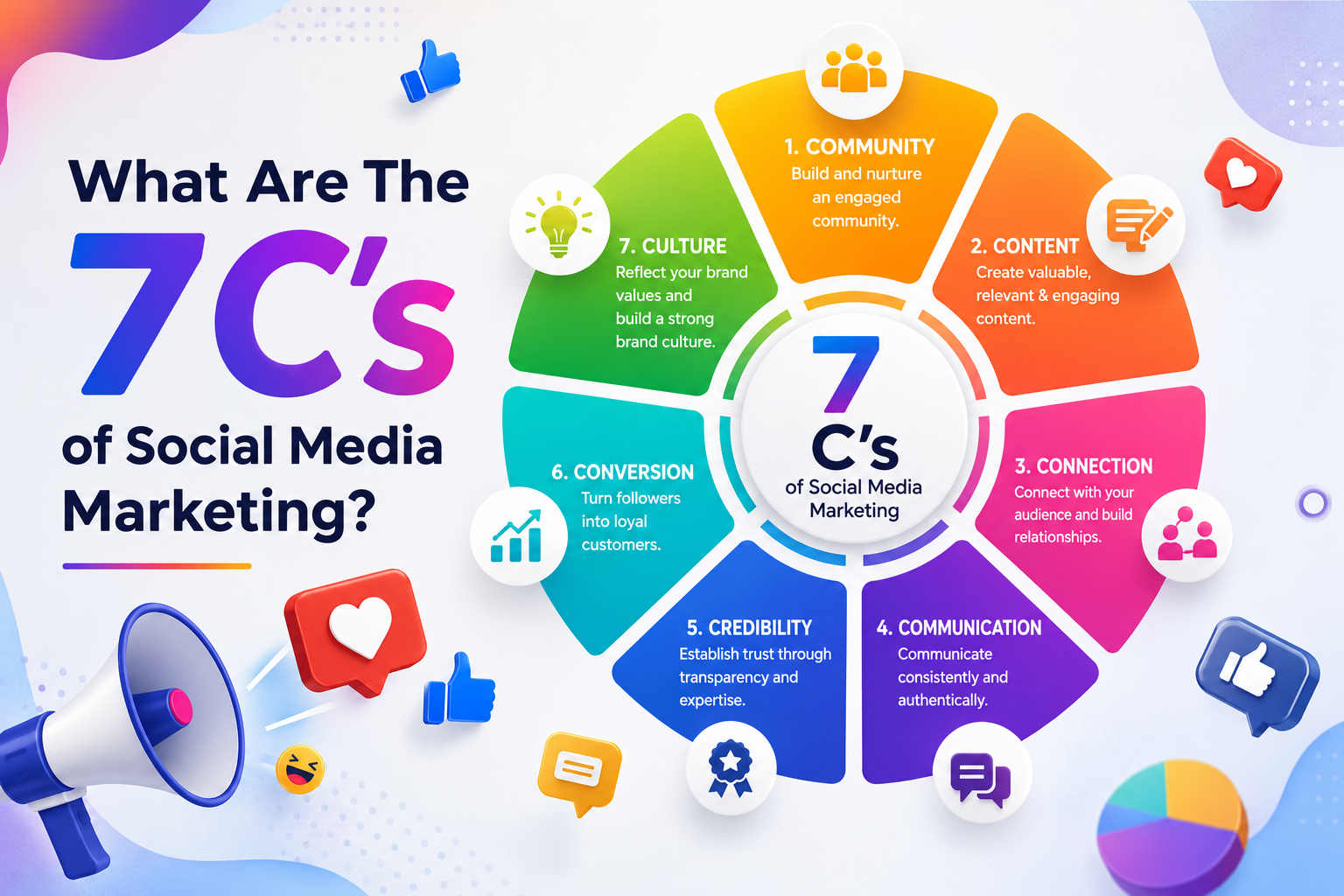
What Are The 7 Cs of Social Media Marketing?
The 7 Cs of Social Media Marketing are Content, Community, Conversation, Connection, Consistency, Credibility, and...
Google Removed FAQ Rich Results, But FAQs Still Help AI Find and Cite Your Website
Short Answer: Yes, FAQs Still Matter More Than Ever Google removed FAQ rich results. A...

How Social Proof and Trust Signals improves Conversion Rate
Social proof and trust signals work. Full stop. Products with just 5 reviews sell 270%...
