The Role of CRO Principles in Improving AI Search Visibility
December 25 , 2025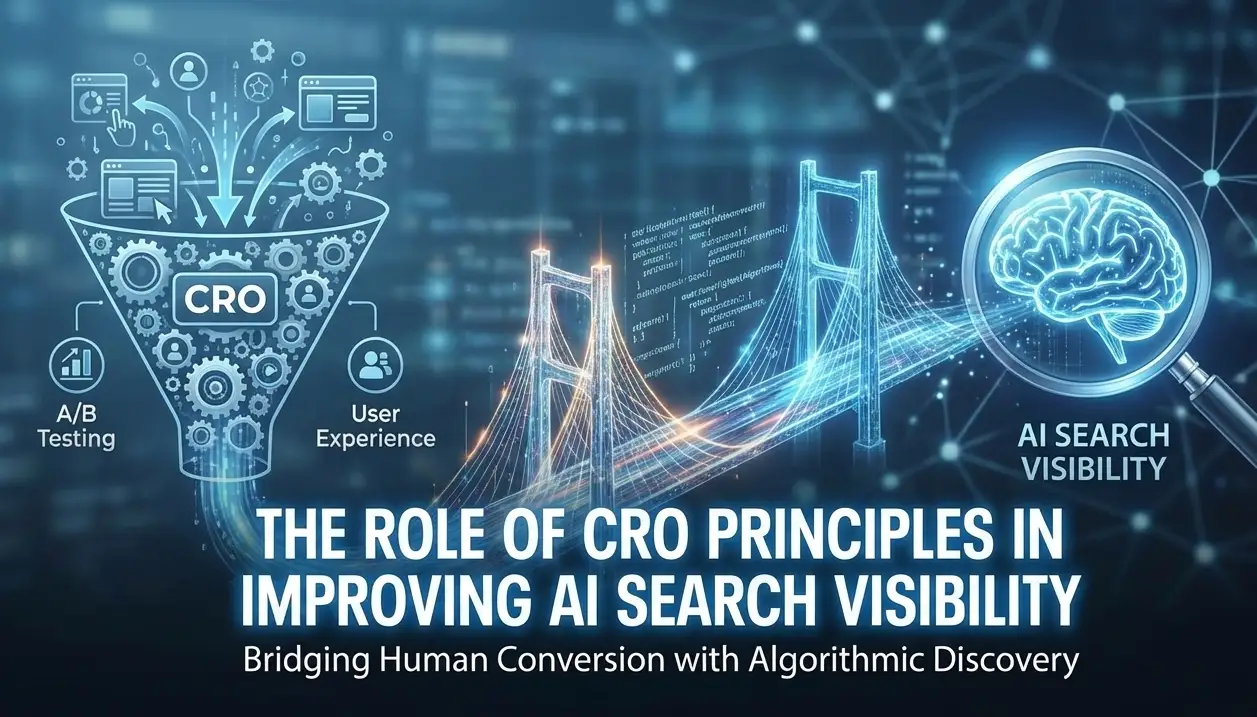
Yes, CRO principles directly improve AI search visibility.
Websites that convert well are easier for AI to understand. Clearer in intent. Better structured. More trustworthy. AI search systems prefer pages that make sense fast. That’s exactly what good CRO creates. If your site converts better, it also gets cited, summarized, and surfaced more often by AI tools like ChatGPT and Perplexity.
Why This Matters Right Now
Search has fundamentally changed. Not just tweaked. Changed.
Google, ChatGPT, Perplexity, and AI Overviews don’t rank pages the way they used to. Keywords alone don’t cut it anymore. They rank by clarity, intent match, structure, usefulness, and how confident the system feels about the answer.
This isn’t traditional SEO thinking. This is AI-first search. And here’s the thing, CRO principles fit it perfectly.
What AI Search Systems Actually Want
AI doesn’t read your website the way you do. It doesn’t skim. It doesn’t get distracted.
It extracts meaning.
AI systems look for four things: clear answers, logical structure, obvious purpose, and strong signals that your page is actually useful. If your site is confusing, bloated, or vague, AI skips it. Or worse, it summarizes a competitor instead.
CRO fixes exactly this problem.
CRO in Simple Terms
CRO = Conversion Rate Optimization.
But modern CRO isn’t just about buttons or forms. It’s about clear messaging, strong hierarchy, one goal per page, removing friction, and matching user intent. Same things that help AI understand your page faster.
Think of it this way: if a human visitor lands on your page and feels confused, an AI system will too.
The Direct Link: CRO + AI Visibility
Here’s how they connect:
| CRO Principle | What It Fixes | AI Benefit |
| Clear headline | Confusion | Strong topic signal |
| One primary CTA | Mixed intent | Clear page purpose |
| Scannable layout | Cognitive load | Easy summarization |
| Trust elements | Doubt | Higher credibility |
| Fast load | Friction | Better usability signal |
Better CRO means better AI interpretation. It’s not complicated.
CRO Principle #1: One Page = One Intent
Pages trying to do everything rank nowhere in AI search.
What AI Needs
AI needs to quickly classify your page as informational, commercial, or transactional. Mixed intent confuses the system. Low confidence = low visibility.
When you try to sell something, educate someone, and show your blog posts all on the same page, you’re telling AI “I don’t know what this is for.” And AI responds by not featuring it.
How to Fix It
Here’s what works:
One main question per page. One main action. One audience. That’s it.
Wrong approach: “Our Services + Blog + Contact Us”
Right approach: “How CRO Improves AI Search Visibility”
See the difference? The second one is clear. AI knows exactly what it’s about. That clarity helps you rank in ChatGPT, Perplexity, and other AI search tools because the system confidently understands your page’s purpose.
CRO Principle #2: Strong Headline Hierarchy
AI reads structure before content. Always.
What AI Looks At
H1 = primary topic. H2 = supporting concepts. H3 = explanations and details.
Weak hierarchy means weak understanding from the AI system. It has to guess at what matters. That’s not what you want.
How to Fix It
Use this structure:
- H1: Your main answer (one per page)
- H2: Key supporting ideas (2–4 of them)
- H3: How / Why / Examples (under each H2)
Avoid:
- Multiple H1s
- Creative but vague headings
- Missing subheadings
When you structure like this, your page becomes AI-readable. A CRO consultant will tell you the same thing applies to user experience that people scan headlines first. AI does too.
CRO Principle #3: BLUF Content Blocks
AI prefers answers first, explanations second.
This matches CRO best practices perfectly. No buried leads.
What Works Best
For every section, give the answer first. Then explain why. Then explain how.
Example structure:
- First sentence: Clear conclusion
- Next 2–3 sentences: Reason + context
- Next 3–4 sentences: Specific steps or examples
This improves featured snippets, AI summaries, and zero-click visibility. It also reduces bounce rate. Humans and AI both reward clarity.
CRO Principle #4: Reduce Cognitive Load
Confused users bounce. Confused AI ignores.
How to Do It
- Short paragraphs (2–4 sentences)
- Bullet points where they help
- Clear spacing
- Simple language
- No filler text
If a human can scan your page and understand it in 10 seconds, AI can process it faster. There’s no secret here. What works for human brains also works for machine learning models.
CRO Principle #5: Clear CTAs Signal Page Purpose
CTAs help AI understand “what is this page actually for.”
AI infers intent from CTA language, placement, and consistency. A strong CTA is a clarity signal.
How to Optimize
Use one primary CTA. Make it specific.
Good examples:
- “Book a CRO Audit”
- “Get AI Visibility Checklist”
- “Download the MUVERA Algorithm Guide”
Bad examples:
- Multiple conflicting CTAs
- Generic “Contact Us” everywhere
This matters because Google’s MUVERA Algorithm, which powers modern search ranking, looks at semantic relevance and intent clarity. When your CTA aligns with your page’s intent, you’re sending a stronger signal to how the system understands and ranks your content.
CRO Principle #6: Trust Signals Matter for AI
AI favors pages that look credible.
Trust Signals AI Notices
- Author clarity (who wrote this?)
- Business details (is this a real company?)
- Reviews and testimonials
- Case studies
- Clear About page
Humans trust an expert. So do AI systems.
How to Implement
Add an author bio. Include your company address. Use real testimonials, not generic praise. Show your expertise clearly.
Trust improves AI citations, summary selection, and visibility consistency. It’s not just for humans, credibility is a machine signal too.
CRO Principle #7: Page Speed and UX Are AI Signals
Slow sites lose AI visibility.
Why
AI systems use UX as a proxy for usefulness. Poor user experience suggests poor usefulness. That signal matters.
Quick Wins
- Compress images
- Reduce unnecessary scripts
- Improve mobile layout
- Avoid intrusive popups
Better UX strengthens AI confidence in your page. It’s that simple.
How CRO Improves Google’s MUVERA Performance
MUVERA focuses on semantic relevance, intent clarity, and entity relationships. CRO improves all three.
Why CRO helps:
- Clear sections = clear embeddings for AI
- Focused intent = stronger relevance signals
- Clean structure = better retrieval
Your page becomes easier to match, rank, and surface. When you apply CRO thinking, you’re naturally optimizing for how modern search systems actually work.
Step-by-Step: How to Apply CRO for AI Visibility
Step 1: Define Page Intent
Ask yourself one question: What is the one thing this page answers?
Step 2: Rewrite the Headline
Make it direct, specific, and outcome-focused. Not clever. Clear.
Step 3: Add BLUF Sections
Start each section with a clear answer. Bury the details after.
Step 4: Remove Distractions
Delete unnecessary links, off-topic sections, and filler text. Every element should earn its place.
Step 5: Add One Clear CTA
Match your CTA to your page’s intent. That’s it.
Common Mistakes to Avoid
- Writing long introductions before the point
- Mixing sales messaging with educational content
- Overusing keywords (AI sees this)
- Ignoring layout and structure
- Writing for bots instead of humans
Good CRO avoids all of these.
The Real Takeaway
AI search does not reward long content, clever writing, or keyword stuffing.
AI rewards clarity, structure, intent match, and usefulness.
CRO principles naturally create all of this.
If you want to win AI search visibility, stop thinking only SEO. Start thinking CRO-first. Conversion-focused websites are the future of how AI systems discover, understand, and surface content.
Your website doesn’t have to be perfect. It just has to be clear.
Popular Post

How Social Proof and Trust Signals improves Conversion Rate
Social proof and trust signals work. Full stop. Products with just 5 reviews sell 270%...

What Are Common CRO Mistakes (And How to Fix Them)
Right now, your website is probably leaving 20–50% of potential customers on the table. Not...

What Is the 80/20 Rule in SEO?
The 80/20 rule in SEO is simple: 20% of your work drives 80% of your...
