Expert strategies to use Google Ads and Meta Ads together
December 23 , 2025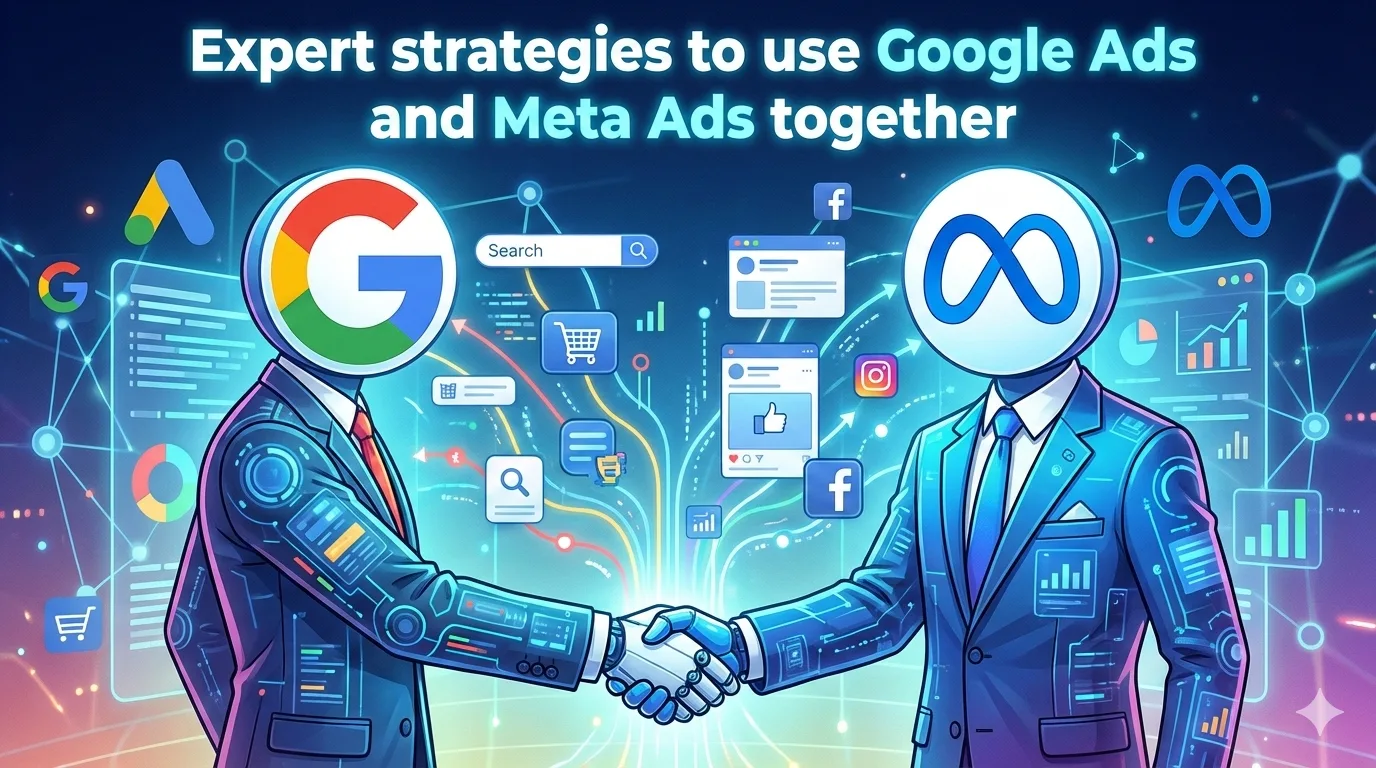
You’re probably throwing money at ads and hoping something sticks. That’s not strategy. That’s gambling.
The difference between a marketer who wastes money and one who consistently increases sales comes down to one thing: understanding where to put your dollars and why. Google Ads and Meta Ads aren’t just different platforms. They work at different stages of what people need from you. Miss that, and you’re fighting with one hand tied behind your back.
Let me show you how to actually make this work.
Why Google and Meta Are Different (And Why It Matters)
Google catches people who are already looking for what you sell. Someone types “buy running shoes” or “best CRM software” and Google puts you right there. It’s search intent. They want it now.
Meta catches people who don’t know they want what you sell yet. You’re building awareness, planting ideas, showing them that your solution exists. It’s different energy entirely. The person scrolling Instagram isn’t ready to buy. But they might be in 30 days if you show them the right thing.
Here’s the practical side: Google has higher intent but lower volume. Meta has massive volume but lower intent. You need both. And the way you split your money between them should match where your customers actually are in their buying journey.
Most people get this backwards.
The Two Core Strategies
Strategy One: The Funnel-First Approach (Best for Most Businesses)
This is the classic playbook that works because it matches human behavior. You’re spending differently at each stage because each stage needs different things.
How the budget breaks down:
Your total ad budget gets divided into three stages based on your campaign maturity:
Early Stage (Months 1-3):
- 50% to awareness campaigns
- 30% to consideration campaigns
- 20% to decision campaigns
- Why? You’re still figuring out what resonates with real audiences and building initial volume
Growth Stage (Months 4-6):
- 30% to awareness campaigns
- 40% to consideration campaigns
- 30% to decision campaigns
- Why? Your conversion data is stronger now, so you shift toward mid-funnel nurturing
Mature Stage (Months 6+):
- 20% to awareness campaigns
- 40% to consideration campaigns
- 40% to decision campaigns
- Why? You know exactly who buys and you’re hunting specifically for those high-intent customers
Google’s role at each stage:
Awareness Stage:
- Use Discovery Ads and Shopping Ads
- Target people searching for broad solutions in your category
- Goal is visibility and clicks, not conversions yet
- Lower intent traffic but quality volume
Consideration Stage:
- Use Search Ads targeting competitor keywords
- Bid on searches like “Slack alternative” or “best project management software”
- People are comparing options now, so show your advantages
- Medium intent but strong conversion potential
Decision Stage:
- This is where Google becomes your main workhorse
- Target your highest-intent keywords with your best-performing ads
- Allocate the largest portion of Google budget here
- People are ready to buy—capture them before they go to competitors
Meta’s role at each stage:
Awareness Stage:
- Use video ads (15+ seconds recommended)
- Run carousel ads and static image ads to cold audiences
- Goal is to introduce your value proposition and build brand recognition
- Cast a wide net—you’re teaching people you exist
Consideration Stage:
- Shift to video testimonials and case study content
- Use carousel format to showcase different features and benefits
- Target warm audiences (people who engaged with your content)
- Answer the core question: “Why should I pick you over competitors?”
Decision Stage:
- Meta becomes your retargeting machine
- Show people who visited your site but didn’t convert
- Use highly targeted messaging focused on conversion
- Add urgency and scarcity where appropriate
- Goal is to push warm prospects across the finish line
The actual allocation table:
| Stage | Google % | Meta % | What You’re Doing |
|---|---|---|---|
| Awareness | 15% | 60% | Building brand, finding audiences |
| Consideration | 35% | 25% | Educating, comparing, building trust |
| Decision | 50% | 15% | Converting warm, retargeting |
This isn’t set in stone. If you sell something with a long consideration cycle (like B2B software), you’d spend more on consideration. If you sell impulse items (apparel, supplements), decision gets more weight. The principle stays the same: match spend to where your customers actually are.
How to set it up on Google:
- Create separate campaigns for each funnel stage (not one giant campaign)
- Awareness campaign: Broad category keywords, informational searches
- Consideration campaign: Solution-based keywords, competitor research keywords
- Decision campaign: Branded keywords, high-intent commercial keywords
- Allocate budget proportionally to campaign importance (decision gets 50% of Google spend)
Bidding strategy by stage:
- Decision campaigns: Use Smart Bidding (Target CPA or Maximize Conversion Value)—let Google’s algorithm find more high-intent people
- Awareness & Consideration: Use Manual CPC or Target CPC—you’re optimizing for clicks and engagement, not conversions yet
Landing page setup:
- Direct awareness traffic to homepage or educational content (let them learn about your solution)
- Send consideration traffic to comparison pages or features pages (help them evaluate you)
- Send decision traffic to pricing page, checkout page, or demo booking page (remove friction to purchase)
How to set it up on Meta:
Cold audience targeting (Awareness):
- Start with broad interest targeting based on your product category
- Use video creative (minimum 10 seconds)
- Don’t expect conversions immediately
- Give campaigns at least 500 conversions before judging performance
Warm audience targeting (Consideration):
- Build custom audiences from your website visitors
- Segment by behavior: product page viewers, video watchers, link clickers who bounced
- Show carousel ads with testimonials and feature breakdowns
- Messaging should be: “You showed interest—here’s why we’re the best choice”
Hot audience targeting (Decision/Retargeting):
- Use website retargeting with dynamic product ads (for e-commerce)
- For B2B/services, use video retargeting and lead generation ads
- These people already know you exist—you’re reminding them of value
- Focus messaging on final objection removal and urgency
The retargeting playbook:
Here’s what most people miss about retargeting. They show the same ad to everyone who visited their site. That’s weak.
Segment by behavior level:
- Create a “cold” segment: People who bounced quickly (under 15 seconds on site)
- Create a “warm” segment: People who spent 30+ seconds, viewed 2-3 pages
- Create a “hot” segment: People who viewed pricing, cart, demo booking, or specific product pages
- Tailor your messaging intensity to each segment (cold gets educational, hot gets conversion-focused)
Build a proper exclusion strategy:
- Create a “converters” audience: People who already bought from you
- Exclude this audience from acquisition retargeting
- Instead, show them upsell ads or complementary product ads
- Showing purchase ads to existing customers wastes money
Frequency and timing matter:
- Cap frequency at 3-5 exposures per person per week
- If someone doesn’t convert after seeing your ad 15 times in a month, they’re not converting
- Move them to a different audience or pause showing them ads
- Excessive frequency kills your ROAS and increases cost
Real example of how this works:
Let’s say you run a SaaS company with a $10,000 monthly ad budget.
Awareness: $2,000 goes to Meta broad targeting. You’re showing 15-second videos about the problem your software solves. CPM is probably $5-8. You get around 250-400 impressions. You’re looking for people who engage (watch rate, click rate), not immediate conversions.
Consideration: $1,500 on Meta, $1,500 on Google. On Meta, you’re retargeting the video viewers with carousel ads showing your features and customer testimonials. On Google, you’re bidding on keywords like “best project management software” and “alternative to Monday.com”. You want people clicking and spending time on your comparison pages.
Decision: $3,000 on Google for branded keywords and high-intent commercial keywords. You’re outbidding competitors. You’re using remarketing ads. You’re doing everything to capture someone ready to buy. $1,000 on Meta for retargeting people who visited your pricing page or demo page.
Result over 3 months: You’re getting qualified leads at a predictable cost. Your conversion rate improves because you’re showing the right message at the right time. Your ROI gets better because you’re not wasting money on people who aren’t ready.
Strategy Two: The Volume-Efficiency Hybrid (Best for High-Growth Moments)
This strategy flips the script. Instead of thinking stage-by-stage, you’re thinking about what makes money fast. You’re running tighter campaigns with less segmentation, but you’re scaling aggressively on winners.
The core idea: Test fast, kill losers, scale winners. Don’t wait for perfect data. Move with conviction.
Budget allocation in the hybrid approach:
- 60% to proven winners: Campaigns and audiences that are already producing sales get scaled immediately
- 30% to testing and experimentation: New audiences, new creative angles, new messaging approaches—some will work, most won’t
- 10% reserve fund: Tactical opportunities that pop up, quick optimizations, rapid scaling when you find surprise winners
Why this aggressive split works:
- Growth isn’t linear—when you find something that works, the market rewards immediate scale
- Waiting for perfect statistical significance means leaving revenue on the table while competitors grab market share
- The business that moves fastest wins, not the business that’s most cautious
Google’s role in the hybrid approach:
Search campaigns (ruthless optimization):
- Identify which keywords and search terms actually convert
- Cut everything else immediately—don’t bid on keywords with high clicks but zero conversions
- Stop wasting money on searches that don’t lead to sales, no matter how tempting the click volume looks
- Focus spend on your proven revenue generators
Performance Max campaigns (AI-driven scaling):
- Give Google a conversion goal and target CPA
- Google automatically places your ads across Search, Display, YouTube, and Gmail
- Run for at least 21 days before evaluating (this is Google’s learning period)
- Check performance after 21 days: if hitting target CPA, scale the budget immediately; if not, pause and test different creative
- Provide varied creative assets: 3-4 different headlines, 4-6 descriptions, multiple images, and video when possible
- Google’s algorithm tests combinations and finds the winning mix
Meta’s role in the hybrid approach:
Meta is your volume generation machine. You’re running broad targeting, lookalike audiences, and retargeting, but with constant creative testing.
The creative testing system:
- Create new ad sets with new creative every 3-5 days
- Don’t overthink variations—test trending audio, customer testimonials, problem-agitation-solution format, user-generated content
- Run each variation at small budget: $5-10 per day
- Let each variation collect 100-200 leads or $500-1000 in spend
- After collecting data, identify which creative has the lowest cost per result
Scale winners immediately:
- If one creative gets leads at $3 while others are at $15, that’s a 5x difference
- Don’t wait for more data—move budget to winners now
- This is where speed beats perfection
The hard truth about creative:
- Most advertisers find one ad that works and run it for three months
- By month two, it’s exhausted (audience fatigue)
- By month three, it’s expensive and underperforming
- Winners keep moving—constant testing isn’t overthinking, it’s the actual game
The science of retargeting in the hybrid approach:
Retargeting here is about speed and recency. Someone visited your site and didn’t convert. You’ve got maybe 5-7 days to bring them back before they forget about you.
Day 1 after visit: Show them a product ad or standard conversion ad. Keep it simple. If they were interested enough to click your ad and visit, they might convert with minimal extra push.
Day 2-3: Show them social proof. Customer reviews, testimonial video, success metrics. You’re addressing the objection: “Why should I trust you?”
Day 4-7: Show them an incentive or scarcity message. “Limited time offer” or “Join X happy customers.” You’re creating urgency.
If they still don’t convert by day 7, move them into a new audience for longer-cycle content. Maybe they need more education. Maybe they need a nurture sequence. But stop hammering them with purchase-now messaging.
The testing matrix:
| Element | Test 1 | Test 2 | Test 3 |
|---|---|---|---|
| Headline | Problem-focused | Benefit-focused | Result-focused |
| Format | Video | Carousel | Testimonial |
| Audience | Broad interest | Lookalike | Website visitors |
| CTA | “Buy now” | “Learn more” | “Get free trial” |
Run three variations. Give each $500-1000 spend. Pick the winner. Spend $5000 on the winner. Then test that winner against three new variations. Keep going.
This isn’t theoretical. This is how the fast-growing companies do it. They don’t try to be perfect. They try to be better than yesterday.
Real example of hybrid approach:
You’re running an e-commerce store selling fitness equipment. Your monthly budget is $15,000.
$9,000 (60%) goes to proven campaigns. Your “dumbbell sets” search campaign is converting at $45 per purchase. You’re scaling it. Your “resistance bands” look-alike audience is doing $38 per purchase. You’re increasing budget there.
$4,500 (30%) is testing budget. You’re running 5 new creative variations on Meta (video testimonials, before-and-afters, fitness tips with your product placement, trending audio, user-generated content). Each gets $300-400. You’re running new search keywords you haven’t tried. You’re testing a YouTube campaign.
$1,500 (10%) is tactical. One video ad is somehow crushing it (maybe it went viral organically). You’re throwing money at it. A competitor is bidding aggressively on a keyword you haven’t tried. You’re testing that keyword.
By the end of month one, you’ve found two new winning creative variations. By month two, those are your 60% base campaigns and you’re testing new things. By month three, you’re doing this again. This is how you don’t plateau. This is how you keep winning.
The Winning Metrics (What to Actually Watch)
Stop watching impressions. Stop obsessing over CTR alone. Watch what matters.
Google metrics that matter:
Conversion rate (visitors to customers):
- This should improve noticeably as your targeting gets better
- Early stage target: 2% conversion rate
- Month two target: 2.5% (showing your messaging is refining)
- Month three target: 3.5% (proving your targeting is working)
- If this metric isn’t climbing, your landing page or offer needs work, not just more ad spend
Cost per acquisition (CPA):
- Track this religiously—it’s your profitability indicator
- This number should drop over time as you optimize targeting and creative
- If CPA is rising while traffic increases, something’s broken (lower quality traffic, worse creative, or landing page decay)
- Compare your CPA to your profit margin—if your CPA is 40% of customer lifetime value, you’re in good shape
Click-through rate (CTR) on decision keywords:
- Target: Above 5% on your high-intent keywords
- If you’re at 2% or below: Your ad copy isn’t compelling or you’re bidding on the wrong keywords
- The keywords you bid on must match what people are actually searching for
- Test different headlines and descriptions to improve CTR
Quality Score:
- This determines how much you pay per click—ignore it at your cost
- Quality Score below 5 means your costs are inflated significantly
- Improve Quality Score by fixing three things:
- Landing page speed (use Google PageSpeed Insights)
- Ad-to-page relevance (headline on ad should match content on landing page)
- Expected CTR (if your ad doesn’t look clickable, Google penalizes you)
Search impression share:
- This tells you if you’re running out of budget
- If you’re capturing 60% of possible impressions but your budget keeps running out, you’re leaving money on the table
- Scale budget on high-performing campaigns immediately
- If impression share drops suddenly, budget might be too low or competition increased
Meta metrics that matter:
Cost per result (lead or purchase):
- This is your actual north star metric—not engagement rate, not video views, not likes
- Track whether this is going up or down month over month
- If cost per result is climbing, creative fatigue is setting in (your audience is tired of seeing the same ads)
- If it’s stable or dropping, your strategy is working
Creative refresh rate:
- If the same ad runs for more than 30 days, it’s tired
- Audience fatigue is real—people stop responding to the same creative
- Keep new variations in testing constantly (testing budget of 20-30% of total spend)
- The goal is to always have fresh creative ready to replace underperformers
Conversion rate from click to purchase:
- This is the often-overlooked metric that reveals landing page problems
- Example: 500 people click your ad, only 10 complete a purchase = 2% conversion rate
- If clicks are high but conversions are low, the problem isn’t your ads—it’s your landing page
- Fix the landing page first before increasing ad spend
- Track this by comparing clicks in Meta to conversions tracked on your website
ROAS (return on ad spend) for paid audiences:
- This shows actual profit, not just traffic
- Minimum acceptable ROAS: 2:1 (for every $1 spent, you get $2 back)
- Good ROAS: 3:1 (for every $1 spent, you get $3 back)
- Excellent ROAS: 4:1 or higher
- If ROAS drops below 2:1, you’re losing money—pause that campaign immediately
- Healthy ROAS varies by industry (e-commerce typically needs 3:1+, B2B services might accept 2:1 if customer lifetime value is high)
The God-Level Moves (What Separates Winners From Everyone Else)
Move 1: Cross-platform retargeting with sequential messaging
Most people retarget on one platform. They chase the same person across two. Smart.
Here’s the god move: You use both platforms but with different messages based on their journey. Someone visits your site through Google Search. You follow them on Meta with a video testimonial. If they watch that video but still don’t convert, you hit them with a Google remarketing ad with a discount code. If they ignore that, you show them a Meta carousel with competitive comparisons.
You’re building a story across platforms. Each touch point addresses a different objection. By the time they see your third or fourth message, they’ve heard the objection answered from different angles. That’s when they convert.
Set this up by importing website visitor lists to Meta as custom audiences. Then build sequential campaigns on Google for people who engaged with your Meta ads but didn’t click through. Use UTM parameters so you know which audience saw which message first.
Move 2: Bidding to profitability, not volume
Most advertisers optimize for lowest cost per click or lowest cost per lead. That’s backwards if your leads have different values.
If you’re SaaS and your enterprise leads are worth 10x your SMB leads, you should bid differently for each. Set up conversion value tracking in Google. Tell Google: “This conversion is worth $1000, this one is worth $100.” Now Google’s algorithm bids higher to get the valuable ones and lower for less valuable ones.
On Meta, do the same thing with conversion value. A $500 customer is worth bidding $50-75 to acquire. A $50 customer is worth maybe $5-10. Let the platform do the math.
This fundamentally changes your ROAS. You’re not chasing the cheapest lead. You’re chasing the most profitable lead.
Move 3: Micro-funnel testing on Meta with continuous optimization
Don’t just test creative. Test your entire flow. Your headline. Your image. Your audience size. Your frequency cap (how often someone sees your ad).
Here’s what winners do: They build 10 small campaigns (budget $100-200 each) with different combinations of variables. Not guessing. Actual testing. In 14 days, 5 of them will have 50% higher ROAS than others.
Kill the bottom 5. Double the budget of the top 5. Create 10 new variations testing different angles against the winners. Repeat.
This is constant evolution. You’re not trying to find the perfect campaign. You’re always improving. Most people run the same campaign for 90 days. Winners run different versions every 14 days.
Move 4: Platform-specific creative format dominance
Google’s Search ads and Performance Max are fundamentally limited by format. You’ve got 30 characters for headlines, set structure. Meta is wide open.
Dominate video on Meta. Forget carousel ads if video crushes it. Forget images if testimonials work better. Find the format that wins on each platform and go all-in.
Then here’s the god move: You use that winner to create better creative for Google. If your video testimonial kills it on Meta and produces a 4:1 ROAS, extract key frames from that video. Use the best quote as a Google search ad headline. You’re multiplying the value of your best creative across both platforms.
Move 5: Layered audience targeting that compounds
Don’t just target people interested in your category. Layer audiences. Someone who’s interested in fitness AND has high income AND recently searched for fitness equipment is a much different person than someone just interested in fitness.
On Google, this is keyword layering. You’re not just bidding on “dumbbells.” You’re bidding on “dumbbells + home workout” (combines two searches). You’re bidding on “dumbbells + cost effective” (addresses price concern).
On Meta, this is detail-level targeting and lookalike combinations. You target people interested in fitness who are also interested in productivity tools (suggests they’re goal-oriented). You target people who follow gym influencers and wellness brands.
Building these compound audiences takes work. But once they’re built, they’re gold because they’re specific. Specificity = higher quality = lower cost.
The Implementation Timeline
Month 1: Build the foundation
Set up proper tracking. UTM parameters everywhere. Conversion tracking on Google and Meta working correctly. Build your funnel campaigns or test campaigns based on which strategy you’re using. Let data collect. Don’t make big moves yet.
Month 2: Analyze and double down
Look at what’s working. Which keywords convert? Which Meta audiences have the best ROAS? Increase budget on winners. Kill clear losers (anything below 2:1 ROAS for Meta, anything below your target CPA for Google).
Test new creative. At least 5 new variations on Meta. Test new keywords on Google. Build your first retargeting audience from Month 1 traffic.
Month 3 and beyond: Systematize the wins
By now, you know what works. You scale it. Your winning campaigns get 70% of budget. New testing gets 20%. Tactical/opportunistic gets 10%.
Keep the creative rotation going. Never rest on one creative. The market changes. Audiences fatigue. You have to feed them new material.
The Real Talk
This works. Both strategies work. The marketing funnel approach works if you’ve got time and patience to build systematically. The hybrid approach works if you’ve got guts to move fast and kill underperformers.
Most people fail because they do neither. They half-commit to building a funnel but keep checking after 2 weeks. They test creatives but never actually kill the bad ones. They’re indecisive.
Pick a strategy. Commit for 90 days. Watch the metrics. Make moves based on data, not feelings. That’s when this stops being theoretical and becomes your actual revenue engine.
The business that outspends competitors isn’t always the one winning. The business that spends smarter is.
Popular Post

How Social Proof and Trust Signals improves Conversion Rate
Social proof and trust signals work. Full stop. Products with just 5 reviews sell 270%...

What Are Common CRO Mistakes (And How to Fix Them)
Right now, your website is probably leaving 20–50% of potential customers on the table. Not...

What Is the 80/20 Rule in SEO?
The 80/20 rule in SEO is simple: 20% of your work drives 80% of your...
