What is Google MUVERA Algorithm? | How it changes the game of SEO
November 25 , 2025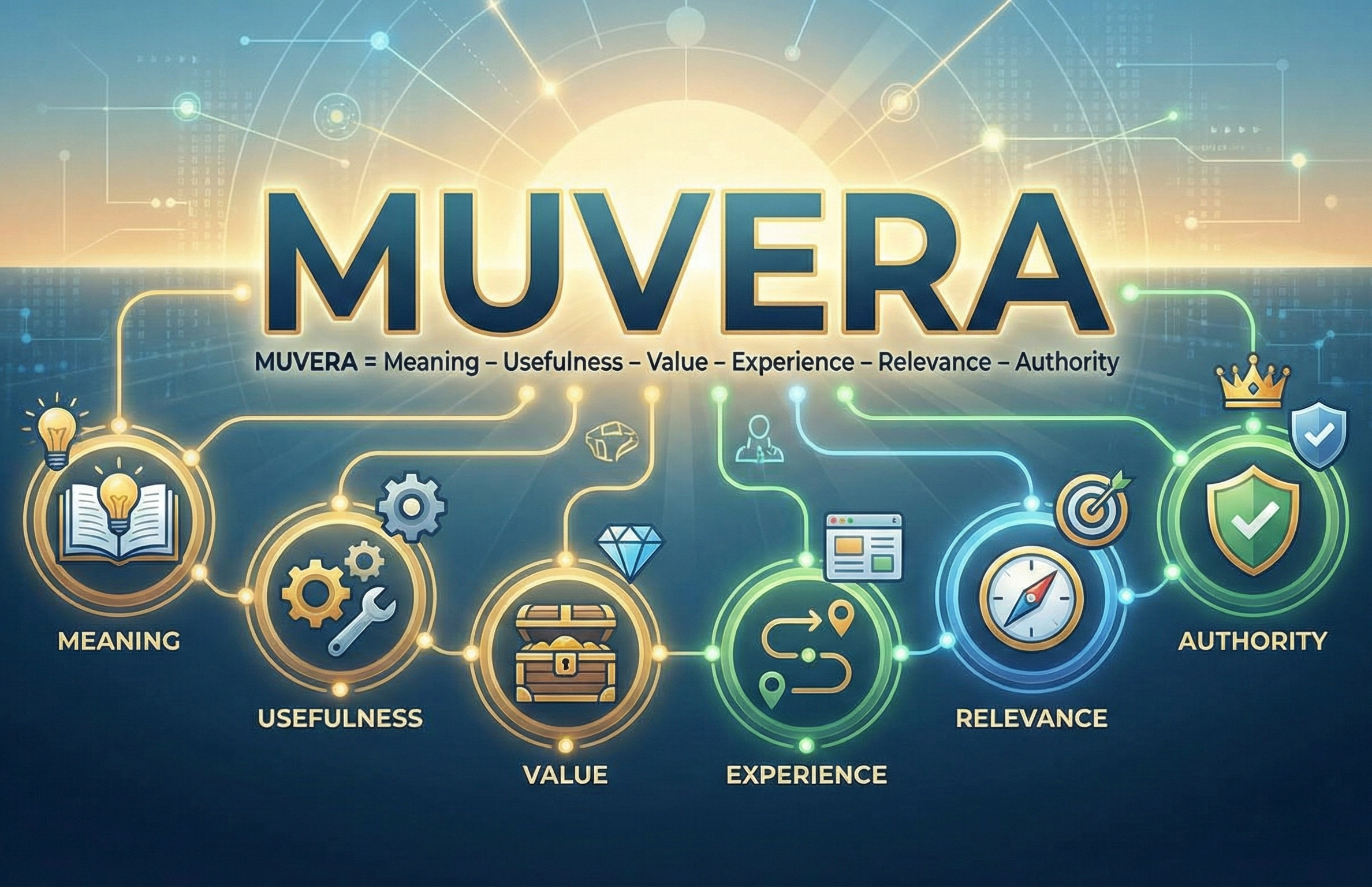
If you’re still doing SEO the way you did five years ago, stop. Google isn’t playing the old game anymore.
Your business depends on being found online. You know this. But here’s what most people don’t: the rules changed. And they changed big.
Welcome to Google MUVERA Algorithm. This isn’t a buzzword. This is how Google ranks websites now.
The Old SEO Playbook Is Broken
Remember when SEO meant stuffing keywords everywhere? “Best pizza restaurant near me” repeated ten times on a page? Yeah, that was the game.
Google used to match keywords. You wrote “blue widgets” enough times, and Google showed your page when someone searched “blue widgets.”
Simple. Mechanical. Over.
The truth is, Google got smarter. Way smarter. It’s now reading meaning, not keywords. Understanding intent, not just syntax. Finding real experts, not just keyword optimizers.
This shift? It’s called MUVERA.
What Actually Is MUVERA Algorithm?
Let’s start with the technical definition. Then we’ll make it simple.
MUVERA = Multi-Vector Retrieval via Fixed-Dimensional Encodings
Yeah. That’s a mouthful. Let’s break it down.
Think about how you describe something to a friend. You don’t just say one thing. You paint a picture with many details at once. “It’s a blue car. Fast. Clean. German-made. Ten years old. Reliable.” Many descriptions together create meaning.
That’s what vectors do for Google.
Google now converts your content into vectors. Vectors are like mathematical fingerprints. Each one captures something different: meaning, depth, authority, clarity, usefulness, trust.
Instead of matching one keyword, Google matches dozens of vectors. It’s like checking ten different angles of the same problem all at once.
Old SEO was one-dimensional. MUVERA is multi-dimensional. That’s the game.
Here’s How Multi-Vector Ranking Actually Works
Imagine Google is a librarian. A really smart one.
You write a blog post about “how to start a plumbing business.” Google reads it. Then it creates a map.
This map isn’t just keywords. It’s vectors. Meaning vectors. Authority vectors. Usefulness vectors. Structure vectors. Trust vectors. And many more.
Then someone searches “starting a plumbing business.” Google creates vectors for that search too.
Google compares your vectors with the search vectors. The closer the match, the higher you rank. The further apart they are, the lower you go.
Here’s the catch: the vectors go deeper than keywords. They measure:
- Does your content match what people actually want?
- Do you really know what you’re talking about?
- Is the information deep and specific?
- Can you prove your experience?
- Is the writing clear and helpful?
- Can someone trust this advice?
If you answer yes to all of these, your vectors align. You rank.
The Simple Way to Understand MUVERA
Here’s a teaching tool we use with our clients. It’s not the technical definition, but it helps real business owners grasp what Google is looking for.
MUVERA = Meaning – Usefulness – Value – Experience – Relevance – Authority
Let’s unpack each one:
Meaning: Does your content answer the actual question? Not just the keyword, but the real intent behind it. Someone searching “how to fix a leaky faucet” doesn’t want to see a Wikipedia entry on plumbing history. They want step-by-step fixes. That’s meaning.
Usefulness: Does it solve a real problem? Can someone read it and actually do something? If your content is all theory and no application, Google knows it. Usefulness matters.
Value: Is it better than what’s already out there? If ten other websites say the same thing, why should yours rank higher? You need something more. Deeper examples. Unique insights. Real case studies.
Experience: Do you show real-world insight? This is huge now. Google wants to know you’ve actually done what you’re teaching. Not just read about it. Done it. Lived it. That comes through in your writing.
Relevance: Is everything connected to your main topic? No random tangents. No keyword stuffing. Just tight, focused content that stays on track.
Authority: Is it credible? Do you cite sources? Do you have credentials? Do other trustworthy sites link to you? Authority signals matter more than ever.
Google uses all six of these factors together. That’s multi-vector thinking.
Why This Changes Everything for Your Business
Old SEO tactics are dead.
Writing 2,000 words on a topic won’t help if the meaning is hollow. Thin content won’t rank just because you repeated keywords. Buying backlinks from random websites won’t boost you if your actual expertise is weak.
But here’s the good news: if you do things right, the results last longer. And they’re harder for competitors to copy.
Think about it. A competitor can copy your keywords. They can’t copy your real experience. They can’t fake genuine expertise. They can’t quickly build true authority in a topic.
MUVERA rewards the real thing. And that’s actually good for honest business owners like you.
The Vectors Google Is Measuring Right Now
Google doesn’t publish exactly which vectors it uses. But we can see the patterns from how pages rank.
Here are the main ones:
Semantic meaning vector: Does the content match what people actually search for?
Intent alignment vector: Do you understand why someone searched this? Are you answering their real question?
Expert authority vector: Do you show proof that you know this topic?
Content depth vector: How detailed is your information? Surface-level or thorough?
User experience vector: Is the content easy to read? Can people find what they need?
Trustworthiness vector: Can readers trust this information? Are there sources and citations?
Entity matching vector: Do you mention related topics and people correctly? Do connections make sense?
Freshness vector: Is this information current? Has it been updated recently?
Google weighs hundreds of these vectors together. Not just one or two. They all matter.
The sites that rank highest excel at most of these vectors. The sites that disappear? They fail at most of them.
Old SEO vs. MUVERA: Side by Side
Here’s how the game changed:
| Old SEO | MUVERA |
|---|---|
| Keywords | Meaning |
| Backlink quantity | Real topical authority |
| On-page signals | Semantic vectors |
| Website focus only | Author reputation matters |
| Ranking pages | Ranking real experience |
| Keyword density | Content depth |
| Technical tricks | User satisfaction |
| Volume | Quality |
The shift is real. And it’s permanent.
Old tactics fail because they don’t address vectors. They’re like trying to win a chess tournament by only moving pawns. You might get lucky once, but you won’t win.
What Does Good Content Look Like Now?
Under MUVERA, your content needs to feel like expert teaching, not marketing fluff.
Real content now includes:
Rich explanations: You don’t just say what something is. You explain why it matters. You show the thinking behind it.
Specific examples: Generic advice ranks nowhere. “Use case studies to prove points” is weak. “We increased leads by 47% by fixing this one thing” is strong. Specificity wins.
Clear structure: Your content should guide readers. Use headings that make sense. Use short paragraphs. Use lists when they help. Make it scannable and clear.
Original insights: What do you see that others miss? What have you learned from doing this work? Your unique angle matters.
First-hand experience: You’ve done the thing you’re writing about. That should be obvious. Show it in examples. Show it in the problems you mention. Show it in the solutions you offer.
Entity-driven writing: Mention related people, tools, concepts, and companies by name. Use them correctly. Google understands how things connect.
Factual grounding: Back things up. Cite sources. Prove claims. Don’t just say something is true and move on.
Google wants content that reads like a real expert explaining to someone they care about. Not a sales pitch. Not fluff. Not AI-generated gibberish.
Content that teaches. Content that helps. Content that’s real.
How to Actually Change Your SEO Strategy
So what do you do? How does a small business owner adapt?
Here are real steps:
Stop thinking about keywords. Think about topics instead. Build content around entities and topics, not just individual keywords. A blog post about “email marketing” should cover automation, segmentation, A/B testing, deliverability, and related tools. Connected topics create stronger vectors.
Add author information. Seriously. Google wants to know who wrote this. Add an author bio. Link to your LinkedIn. Show your credentials. If you have expertise, prove it. This signals authority vectors.
Include real examples and case studies. Don’t just say what works. Show it. “We helped a landscaping company increase bookings by 63% using these three strategies.” Specific results matter.
Make your intent crystal clear. Ask yourself: what is someone actually trying to do when they search this? Then answer that question. Answer it completely. Don’t assume. Ask.
Structure content thoughtfully. Use headings that make sense. Use short paragraphs. Use bullet points where appropriate. Make it easy to scan. Readability isn’t just nice to have. It’s a vector.
Update content regularly. Freshness matters. If something is outdated, update it. If new information appears, add it. Show Google your content is current.
Be specific. Always. “This will help your business” is weak. “This will help you close 10% more sales” is strong. Specificity registers in vectors.
Link to related content thoughtfully. Don’t just link everywhere. Link to content that actually connects. Help readers understand how topics relate.
What This Means for Your Digital Marketing
If you work with a digital marketing consultant, they need to understand MUVERA. Really understand it. Not just nod along.
Search Engine Optimization isn’t about tricks anymore. It’s about being genuinely good at what you do. And proving it online.
This is actually better for you. It means your real competition isn’t just anyone with a website. It’s only people who are actually good at your craft. People with real expertise. People with real results.
You can beat them. But you have to do it the right way.
You have to be better. You have to share what you know. You have to show that you’ve actually done the work.
The Future of Search Is Already Here
Search with AI is happening now. Google’s AI summaries? They’re pulling from the highest-ranking content. The content with the strongest vectors.
As AI takes over search results, only content with strong vectors gets cited. Only content with real authority makes it into AI summaries. Only trustworthy, deep, expert-driven content gets amplified.
Websites without these vectors? They disappear. No traffic. No visibility. No business.
But this isn’t scary if you’re doing things right. If you’re writing real content. If you’re an actual expert. If you’re helping people.
Then you’ll be fine. Better than fine. You’ll win.
Here’s the Truth About MUVERA
MUVERA isn’t a trend. It’s not something Google will undo next year. It’s the foundation of how search works now.
The shift from keywords to meaning. From tricks to transparency. From quantity to quality.
It’s permanent.
Business owners who adapt early win. They build stronger online presence. They rank for more searches. They attract more customers.
Those who ignore it? They get left behind. Slower. Less visible. Out-competed.
The good news: you’re reading this now. You know what’s happening. You can adapt.
It takes work. Real work. Building better content. Showing your expertise. Being consistent. But it works.
And it lasts. Unlike old SEO tricks that break when Google updates, MUVERA rewards what’s actually good. That’s sustainable. That’s profitable. That’s worth doing.
What Now?
You know what MUVERA is. You know how it works. You know what content looks like under this new system.
The question is: are you ready to adapt your strategy?
Are you ready to build content that actually reflects your expertise? Content that helps people? Content that’s built on meaning, not keywords?
If the answer is yes, you’re ahead of most businesses. Most are still stuck in the old playbook.
But not you. You’re ready to move forward.
The question is: how do you start? Where do you focus? How do you make sure every piece of content aligns with MUVERA vectors?
That’s where professional help makes a difference.
Ready to Dominate Search with MUVERA?
Your competitors are still playing the old SEO game. You don’t have to.
At our company, we specialize in AI automation for small businesses. We help you build content strategies based on MUVERA principles. We help you show Google that you’re a real expert. We help you rank for searches that actually matter.
Whether you need help with Search Engine Optimization strategy or you want a digital marketing consultant to guide your entire content plan, we’ve got you.
Let’s talk about your strategy.
Contact Rushik Shah for professional Search Engine Optimization Services and let’s build a strategy that actually works.
Your business is too important to rely on outdated tactics. Let’s move forward together.
Ready to adapt? Reach out today. Let’s make sure your content ranks because it’s genuinely good. Not because of tricks. Not because of keywords. But because it’s real.
Popular Post
What Are The 7 Cs of Social Media Marketing?
The 7 Cs of Social Media Marketing are Content, Community, Conversation, Connection, Consistency, Credibility, and...

Google Removed FAQ Rich Results, But FAQs Still Help AI Find and Cite Your Website
Short Answer: Yes, FAQs Still Matter More Than Ever Google removed FAQ rich results. A...

How Social Proof and Trust Signals improves Conversion Rate
Social proof and trust signals work. Full stop. Products with just 5 reviews sell 270%...
