What Is the 80/20 Rule in SEO?
February 16 , 2026
The 80/20 rule in SEO is simple: 20% of your work drives 80% of your results.
Most businesses waste time on busywork. They write blogs nobody reads, chase random keywords, and fix technical issues that don’t matter. Meanwhile, a small group of high-value pages, keywords, and links does all the heavy lifting.
Your job? Find that 20% and double down on it. Ignore everything else.
Why Most SEO Fails (And It’s Not What You Think)
You’ve probably heard the advice: “Write more content. Build more links. Fix all your technical issues.”
It doesn’t work.
Here’s what actually happens. Businesses create 100 blog posts, but 12 of them bring 85% of the traffic. They chase 500 keywords, but maybe 40 actually convert. They fix dozens of minor technical problems while ignoring the ones that actually hurt user experience.
The result? They stay busy. Really busy. But traffic stalls and revenue doesn’t grow.
SEO isn’t about doing more work. It’s about doing the work that moves the needle.
Think about it: If you could choose between writing 20 new blog posts or updating your top 5 pages with better examples, better internal links, and clearer calls to action, which would actually get you more leads?
Most teams pick option one. The wrong choice.
The 5 Core Areas Where 80/20 Actually Works
1. Keywords: Finding Buyers, Not Just Visitors
The Truth
Not all search traffic is created equal. A user searching “how do I learn SEO” behaves completely differently from someone searching “SEO services near me.”
One is informational. The other is ready to buy.
Why This Matters
A search engine optimisation consultant will tell you the same thing: 80% of keywords your site ranks for probably bring zero leads. They’re just taking up space. Meanwhile, a small cluster of high-intent keywords drives most of your actual business.
How to Find Your Money Keywords
Start in Google Search Console. Sort by queries that bring clicks. Then look at your analytics and check which of those clicks actually convert to leads or customers.
Your sales team probably knows these keywords already. Ask them what questions prospects ask. Ask them what problems they solve. Those conversations are gold.
High-intent keywords include words like “best,” “cost,” “pricing,” “vs,” “near me,” and “services.” They signal someone’s ready to make a decision.
Real Impact: One Company’s Story
A B2B software company had 450 ranking keywords. But when they looked at conversions, just 37 keywords accounted for 79% of their leads. They stopped chasing the other 413 and instead doubled down on content around those 37 keywords. In six months, lead volume increased 156% without creating a single new page.
2. Content: Your Power Pages Are Hiding in Plain Sight
The Truth
You’ve probably got one or two pages that drive most of your traffic. Maybe a product page. Maybe a resource that keeps getting shared. But you’re ignoring it while you write new content.
Why This Matters
Google’s algorithm rewards content that actually satisfies users. And users keep coming back to pages that deliver real value. If you’ve already got a page that does this, updating it beats starting from scratch every single time.
How to Find Your Power Pages
Open Google Analytics. Sort your pages by traffic. Then look at conversions. Your top 10 pages are probably doing 60 to 70% of the work for your entire site.
Now ask yourself: When did you last update these pages? Most people never do.
How to Improve What Already Works
For each power page:
Add recent data and examples. Refresh outdated statistics. Link internally to related pages so traffic flows to other important content. Add FAQs that answer the questions visitors actually have. Improve your headlines and meta descriptions so more people click through from search results. Add schema markup so Google understands what your page is about. Insert clear calls to action above the fold. Tell people what to do next.
Don’t start over. Improve what’s working.
Real Impact: A Service Business Example
A marketing agency had a page on “how to calculate marketing ROI.” It wasn’t fancy, but it ranked for a cluster of keywords and brought steady traffic. The team kept ignoring it because they wanted to write newer, “better” content.
Then they updated it. They added current examples. Added internal links. Added a signup form for their ROI calculator tool. Traffic stayed the same, but conversions jumped 47% in three months. One page update beat six months of new content creation.
3. Technical SEO: Fix the Big Blockers, Ignore the Noise
The Truth
Technical problems come in different sizes. Some wreck your rankings and hurt users. Others are just annoying warnings in your tools.
You need to know the difference.
Why This Matters
Google cares about one thing: Can users find what they need quickly and easily? Technical problems that get in the way matter. Technical problems that don’t affect users don’t.
A search engine optimisation consultant focusing on technical SEO checklist priorities will tell you to ignore the minor issues and fix what actually breaks the experience.
What Actually Moves the Needle
Focus on page speed. Mobile usability. Core web vitals, which measure how fast and responsive your pages are. Indexing errors that prevent pages from showing up in search. Broken links and missing pages.
Ignore the warnings in your tools about minor HTML issues or old CSS code. Ignore redirect chains that don’t exist yet. Fix what breaks the user experience first.
Your Technical SEO Checklist: The 20%
Check your page speed on Google PageSpeed Insights. Most sites lose 30 to 50% of traffic from slow pages. Test mobile usability directly on your phone. It’s faster than any tool. Look at your core web vitals in Google Search Console. Focus on largest contentful paint, first input delay, and cumulative layout shift. These three metrics predict whether users stay or bounce. Search for indexing errors and fix the ones preventing real pages from being found. Check Google Search Console for broken pages and remove them or fix the links.
Real Impact: Speed Changed Everything
A news site had terrible page speed. Average load time was 4.8 seconds. They weren’t doing anything fancy, just bad server configuration and unoptimized images. A consultant helped them fix it. Load time dropped to 1.2 seconds. Traffic jumped 34% just from the speed improvement alone. They didn’t write new content. They didn’t build new links. They fixed the core web vitals and everything improved.
4. Backlinks: Quality Over Quantity Wins Every Time
The Truth
One strong backlink from a trusted site beats 50 weak links from random directories.
Why This Matters
Backlinks signal trust to Google. But Google got smart. It learned that a link from an industry authority matters way more than 50 links from unrelated sites. Your job is finding those high-value links, not hoarding quantity.
How to Find Quality Link Opportunities
Look for relevant industry sites that already link to similar content. Find partnership opportunities with companies you actually work with. Guest post on authority blogs in your space, not random sites with no traffic. Use digital PR to get mentions from reputable publications.
Skip the spam. Avoid link farms. Avoid cheap backlink packages that promise 500 links for $99. They damage your credibility.
How to Build Real Links
This takes more time than buying links. But it works.
Research five sites in your industry that are worth linking to you. Reach out directly. Explain why your content is valuable for their audience. Offer to write something custom. Or find broken links on authority sites that you can fix by suggesting your content as a replacement.
Real Impact: One Link Moved the Needle
A SaaS startup chased 200 low-quality links over a year. Barely moved the needle on rankings. Then they landed one guest post on an industry publication with real authority. That single link, plus a mention in a newsletter, shifted their traffic. Within months, that one quality link helped them dominate three key search terms. More links from authority sites followed. They stopped chasing quantity and started getting strategic.
5. Conversion Optimization: Your Pages Need Jobs to Do
The Truth
Traffic means nothing if it doesn’t convert. And here’s the good news: a few small changes often increase conversions faster than writing new content.
Why This Matters
You can spend months building pages and links. Or you can spend two weeks improving the pages you have. Guess which actually turns visitors into customers?
The High-Impact Changes That Work
A clear headline that says exactly what you do. A strong value promise that explains why someone should care. Simple forms that don’t ask for their life story. Visible calls to action that tell people what to do next. Trust signals like customer logos, reviews, or certifications. Real case studies with numbers, not fluff.
How to Test and Improve
Pick your top converting page. Change one thing. Maybe the headline. Maybe the form. Track how many conversions increase. Do it again next week. Small changes compound.
Real Impact: Form Changes Generated Leads
A financial services company had 3,000 monthly visitors to their main service page. Conversion rate was 2.1%. They changed one thing: reduced their form from eight fields to four fields. Just removed the less critical ones. Conversion rate jumped to 3.4%. Same traffic. 62% more leads. Then they added two customer testimonials above the form. Conversion hit 4.1%. Three changes. 95% more leads from the same traffic.
How to Find Your 20% (Step-by-Step Audit)
This isn’t complicated. Anyone can do it.
Step 1: Identify Your Top Pages
Open Google Search Console. Look at the “Performance” report. Sort by clicks. Which pages bring the most traffic?
Open Google Analytics. Look at conversions. Which pages actually convert visitors into leads or customers?
Write down your top 10 pages. These are your power pages.
Step 2: Identify Your Converting Keywords
In Google Search Console, look at the “Performance” report again. Which search queries bring the most conversions? Ignore traffic. Look for conversions.
Write down the top 20 queries. These are your money keywords.
Step 3: Update Only Your Winners
For each top page:
Refresh the content with recent data. Add internal links to related pages. Include FAQs that answer common questions. Improve the title and meta description. Add schema markup. Add a clear call to action. Consider adding customer reviews or case studies.
Don’t write 20 new blog posts. Update five strong ones instead.
Step 4: Match Content to Search Intent
Search intent comes in four types: informational (learning), commercial (comparing), transactional (buying), and navigational (brand searching).
If someone searches “how to choose a CRM,” they want informational content that explains features. If they search “best CRM for small business,” they want comparison content. They’re not the same thing.
Check your top pages. Do they match the intent of the keywords they rank for? If not, they’ll never convert.
Real Example: How 80/20 Worked for a Real Business
Imagine a business with 100 blog posts.
But just 12 of them bring 85% of traffic.
The old approach: Write 20 more posts to try and hit another winner.
The 80/20 approach: Update those 12 posts. Make them better. Deeper. Add more examples. Build more links to them. Add conversion elements like CTAs. Expand them into topic clusters where related content links back.
Results? Traffic grew 40% in four months. No new content. Just smarter work.
The Mistake Everyone Makes: Length Over Real Value
Old SEO thinking said: More words equals better rankings. More blog posts equals more traffic.
Search engines used to reward volume. Not anymore.
Google now cares about user satisfaction. Content quality. Clear answers. Experience signals. Whether people actually stay and read your stuff.
So give the answer first. Explain after. Respect people’s time.
A 1,000-word article that answers the question in the first 200 words beats a 3,000-word article that makes people dig for the answer.
The Smart 80/20 Framework for SEO Success
Here’s your actual strategy:
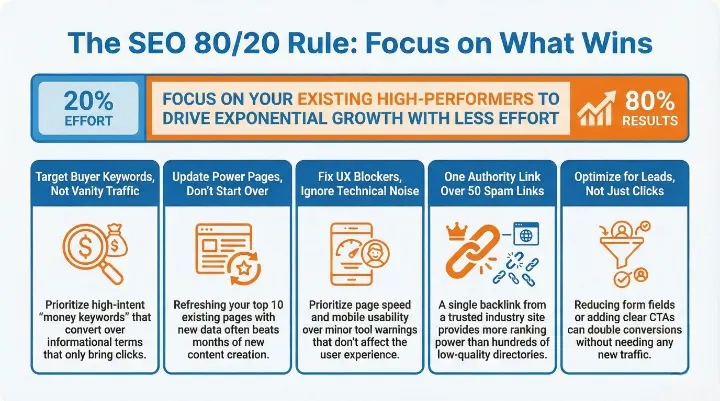
Focus on service and money pages first. These pages have real intent behind them. Someone’s ready to take action.
Target buyer keywords, not vanity traffic. Rank for terms that turn into customers, not just impressions.
Improve your top performers until they dominate. Scale what works instead of chasing new ideas.
Build a few strong links instead of hundreds of weak ones. Quality authority signals beat quantity every time.
Make conversion optimization as important as ranking. Visitors who don’t convert are just noise.
Why Modern Search Algorithms Reward This Approach
Google now analyzes content depth. It looks at user behavior signals. It measures authority and relevance clusters. It checks topical coverage and E-E-A-T signals.
When you focus on the 20% that drives real engagement, you naturally improve all of these. Your top pages get more links. They get more user signals because they’re actually useful. Your conversion pages tell Google the content delivers real value.
That’s why the 80/20 rule works in modern SEO. It’s not a hack. It’s alignment with how search engines think.
Your Action Plan (Use This Weekly)
This is simple enough to follow every week:
Review your top pages in analytics. What’s working? What’s not?
Update your best content with recent data, better examples, or clearer CTAs.
Improve internal linking so traffic flows between related pages.
Optimize your calls to action and conversion elements.
Build one quality link through outreach or content placement.
Remove or consolidate weak pages that don’t convert and never will.
Track conversions, not just traffic. That’s what matters.
The Final Word
The 80/20 rule in SEO isn’t a trick or a shortcut. It’s focus.
Most businesses waste time on low-impact work that feels productive but doesn’t move the needle. Winners focus on the small group of actions that drive real results.
When you work with a search engine optimisation consultant or build your own program, this principle becomes your compass. Do less. But do the right things.
That’s how SEO becomes predictable. That’s how it becomes profitable. And that’s how most successful strategists approach the work, whether they’re managing their own sites or advising clients on growth.
Popular Post
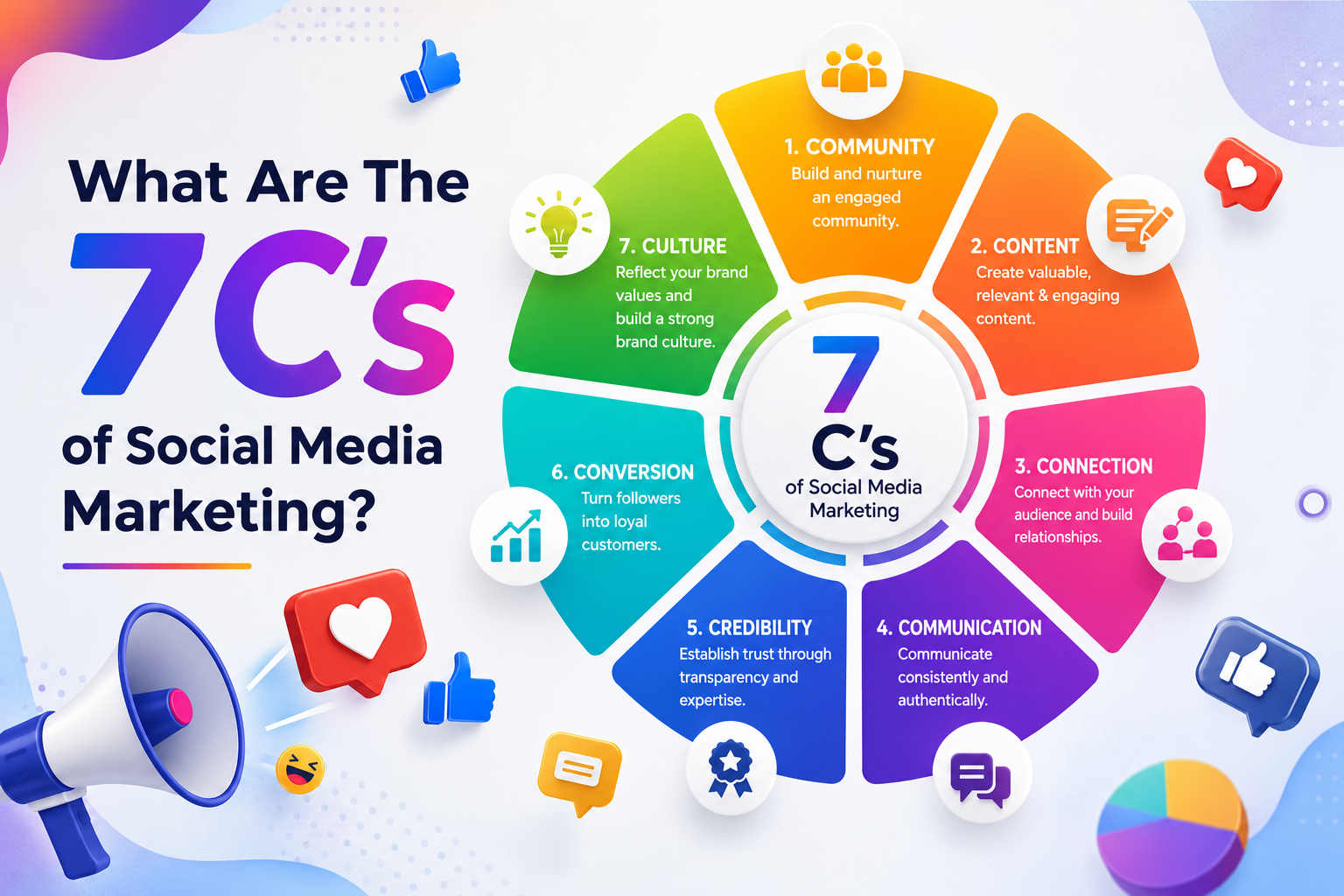
What Are The 7 Cs of Social Media Marketing?
The 7 Cs of Social Media Marketing are Content, Community, Conversation, Connection, Consistency, Credibility, and...
Google Removed FAQ Rich Results, But FAQs Still Help AI Find and Cite Your Website
Short Answer: Yes, FAQs Still Matter More Than Ever Google removed FAQ rich results. A...

How Social Proof and Trust Signals improves Conversion Rate
Social proof and trust signals work. Full stop. Products with just 5 reviews sell 270%...
