What is Search Everywhere Optimization: The New SEO
December 09 , 2025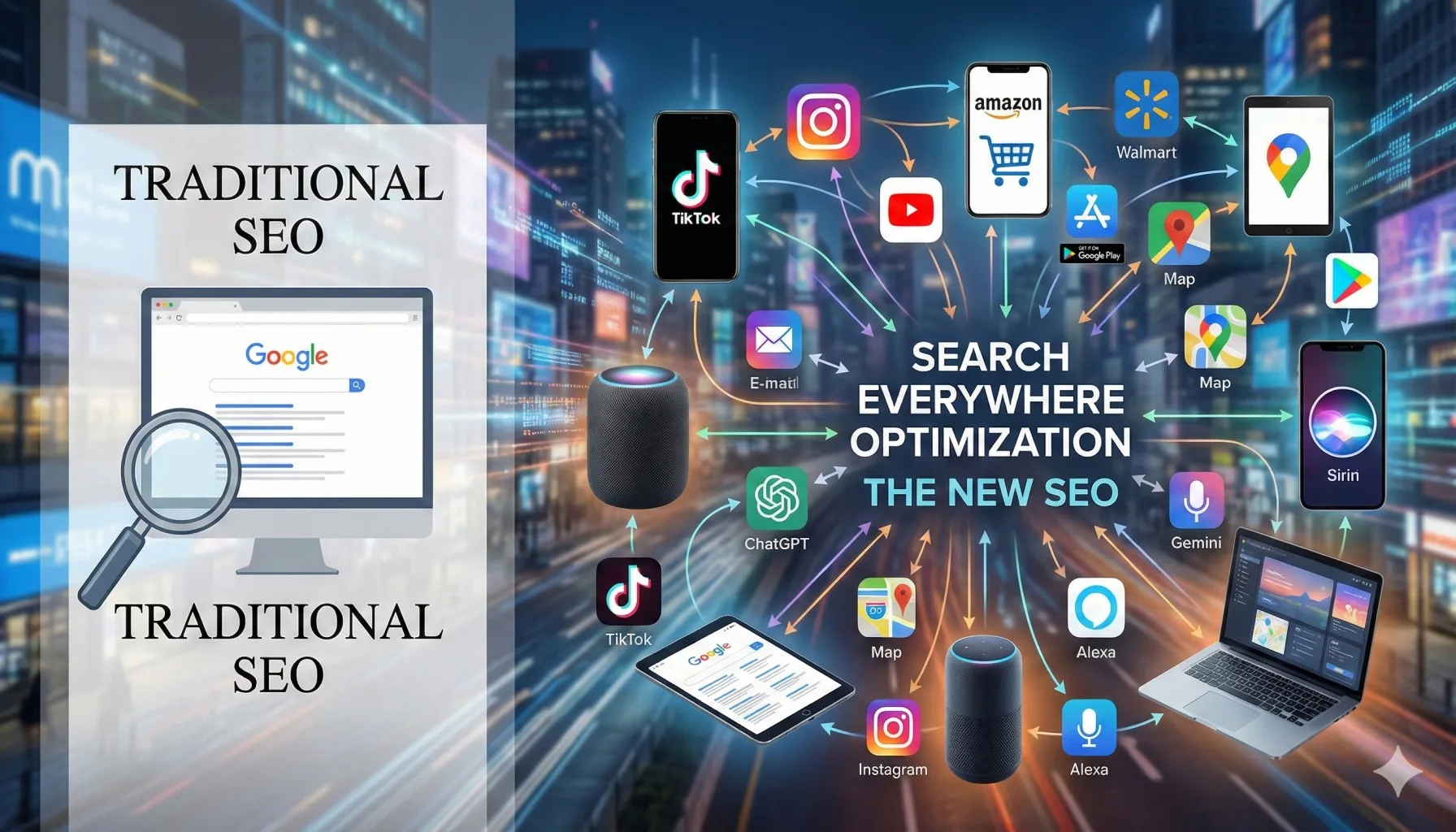
John stares at his Google rankings. They’re good. Really good. Top three for his main keywords.
But his phone barely rings.
He gets visitors. Decent traffic. But they’re not converting. And the scary part? He’s starting to notice something. Customers are finding his competitors on places he’s never even thought about.
YouTube. Amazon. TikTok. ChatGPT. Reddit. Instagram. LinkedIn. Maps.
Last week, a client mentioned finding a competitor on TikTok. Another mentioned seeing a similar business recommended in ChatGPT. John ranked number one on Google for his service. But he was invisible everywhere else.
That’s when it hit him: “If my customer is searching everywhere… why is my SEO only on Google?”
A Business Owner With a Search Problem
John’s situation is more common than most people realize.
His website ranks well on Google. The traditional SEO worked. He did everything right: keywords, backlinks, site speed, mobile optimization. All the standard stuff.
But he’s learning something new: search isn’t just Google anymore.
His customers – the actual people buying his service – aren’t searching only on Google. They’re searching everywhere. YouTube when they want to see how something works. Amazon when they want to compare products. ChatGPT when they have a quick question. TikTok when they’re scrolling. Instagram when they’re shopping. Maps when they need to find him locally.
John optimized for one place. His customers search in twenty.
And he’s confused. “What am I supposed to do? Optimize for everything?”
That’s the confusion most business owners feel right now.
Customers Now Search in 100 Different Places
Here’s what’s actually happening in the market.
Customers don’t search only on Google. Not anymore.
They search on YouTube when they want tutorials. On Amazon when they want products with reviews. On TikTok when they want trend-based inspiration. On ChatGPT when they want instant answers. On Reddit when they want honest community opinions. On Pinterest when they want visual ideas. On LinkedIn when they want professional answers. On Instagram when they’re shopping. On Google Maps when they need something nearby. On AI assistants built into their phones. Inside marketplaces like Etsy, Shopify, and specialty sites.
They’re not thinking, “I’ll search Google.” They’re thinking, “Where can I find this fastest?”
And here’s the internal problem:
Business owners feel lost. They don’t know what to optimize anymore. Traditional SEO told them: optimize for Google. Now there’s no single Google. There’s Google, YouTube, TikTok, ChatGPT, Instagram, Amazon, and dozens more.
The question becomes: “Do I need to optimize for all of them?”
The Problem With Traditional SEO
Traditional SEO assumed one thing: people search on Google.
So the entire strategy revolved around Google: get backlinks, nail your keywords, improve your technical SEO, build domain authority. All Google-focused.
But here’s the catch: that assumption is dead.
Most business owners who only do traditional SEO are experiencing the same problem. Decent Google rankings. Flat sales.
Why? Because their customers evolved. They’re not searching only on Google anymore. They’re scattered across dozens of platforms.
A plumber ranks number one on Google for “emergency plumber near me.” Great. But what about the homeowner who asks ChatGPT, “Who’s a good plumber?” The plumber isn’t in ChatGPT’s knowledge base. So a competitor shows up instead.
A fitness coach ranks well on Google. But potential clients are on Instagram looking at transformation stories. They’re on TikTok watching quick tips. They’re on YouTube watching full workouts. The coach is invisible in all those places.
This is the real problem: Traditional SEO only solves for one channel. Your customers search in many.
Search Everywhere Optimization Explained
Here’s the concept that changes everything: Search Everywhere Optimization.
It means your business shows up wherever your customer searches. Not only on Google. Everywhere.
Think of it like this. Old SEO was trying to catch fish in one river. Search Everywhere Optimization is recognizing that fish are swimming in twenty rivers. So you cast your line in all of them.
Why this works:
Modern search systems don’t work like they used to. They don’t just match keywords. They understand meaning. They understand intent. They understand context.
Google’s algorithm used to ask: “Does this page have the right keywords?” Now it asks: “Does this person appear helpful and trustworthy everywhere they show up?”
Algorithms across platforms now reward consistency. They reward presence. They reward helpful content. They reward trust signals.
When someone shows up on Google, YouTube, Instagram, ChatGPT, Reddit, and Maps all saying the same helpful thing, platforms notice. Trust increases. Visibility increases.
Search Everywhere Optimization is simple: Be helpful everywhere your customer looks.
Where People Search Today (The Complete List)
Let’s get specific about where your customers are actually searching.
Search Engines & Maps:
- Google Search
- Google Maps
- Bing
Video Platforms:
- YouTube
- TikTok
Shopping Platforms:
- Amazon
- Etsy
- eBay
- Specialized marketplaces
Social Platforms:
- Instagram (Search & Shopping)
- Facebook Search
- LinkedIn Search
- Pinterest Search
Community & Q&A:
- Quora
- Discord communities
AI & Smart Assistants:
- ChatGPT & OpenAI Search
- Google Gemini
- Voice assistants (Alexa, Siri, Google Assistant)
Business Directories:
- Yelp
- Yellow Pages
- Industry-specific directories
Pick the five platforms where your customers actually spend time. That’s where you start.
Step 1: Be Findable Everywhere
The first step is simple: make sure people can find you.
Create platform-specific content. Don’t just copy-paste your Google content everywhere. YouTube needs video. TikTok needs short clips. LinkedIn needs professional posts. Instagram needs visuals. Reddit needs authentic community answers. Create for each platform’s format.
Add product/service info to all platforms. If someone looks for you on YouTube, they should find you. On Instagram, they should find you. On Google Maps, they should find you. On Amazon, if you sell products, they should be there with reviews. Complete your profile everywhere.
Update all social profiles. Your Instagram bio should match your message. Your LinkedIn headline should be clear. Your TikTok description should say what you do. Consistency across platforms signals that you’re real and active.
Publish short helpful content on major channels. Don’t need to be everywhere, but be somewhere beyond Google. YouTube deserves regular videos. Instagram deserves helpful carousel posts. TikTok deserves quick tips. Reddit deserves genuine answers. Pick 2-3 and commit.
Real impact: A home services business added themselves to Google Maps, Instagram Business, and YouTube. Calls increased 25% in three months just from being findable.
Step 2: Match User Intent
Being findable isn’t enough. People need to see what they’re looking for.
Use simple language. Someone searching on ChatGPT is asking a quick question. Use short, clear answers. Someone on YouTube wants to learn. Use educational content. Match the mindset of each platform.
Answer real questions. What are people actually asking on each platform? On Reddit, people ask honest questions. Answer them. On Quora, same thing. On ChatGPT, people ask specific problems. Provide solutions.
Create guides, FAQs, how-tos. These work everywhere. A guide on “How to Choose a Contractor” works on YouTube, your blog, LinkedIn, TikTok (as a series), Instagram (as carousel posts), and more.
Cover the full journey: problem, solution, benefit. Someone on YouTube might be in the awareness stage. Someone on Google Maps is ready to buy. Someone on Reddit is comparing options. Cover all angles.
Real example: A digital marketing services agency created “What I Wish I Knew About Marketing” content and published it as:
- A YouTube video (14 min)
- A blog post (2,000 words)
- Instagram carousel (10 slides)
- TikTok series (5 videos)
- Reddit AMA (Ask Me Anything)
One insight. Multiple formats. Result: ranked on first page for “marketing agency” across Google, YouTube recommendations, and Instagram Search.
Step 3: Optimize for Trust Signals
Here’s what makes Search Everywhere Optimization different from old SEO: platforms reward trust.
When algorithms see multiple signals of trustworthiness, they boost visibility.
Add reviews everywhere. Google, Yelp, Amazon, industry sites. Reviews signal that people trust you.
Add user-generated content (UGC). Real customer photos. Real testimonials. Real case studies. This is more powerful than marketing copy.
Add social proof. Customer logos. Testimonial videos. Case study numbers. Trust is contagious.
Publish product/service demos. Real videos showing how you work. Not polished commercials. Real work. People trust what they see.
Use clear images and descriptions. Blurry photos and vague descriptions signal low trust. Clear, professional content signals you care.
Build presence, not perfection. Someone who shows up consistently on five platforms with honest content gets more trust than someone who shows up perfectly on one platform.
Real Success Story: John’s Transformation
Let’s come back to John. Here’s what happened when he shifted strategy.
Before: John ranked #1 on Google for his main keywords. But sales were flat. He relied entirely on Google traffic.
What he did:
- Created YouTube videos showing his work process (1 video/week)
- Set up Instagram Business and posted helpful carousel posts (3x/week)
- Claimed his Google Maps listing and added photos/updates
- Answered questions on Reddit’s industry community
- Published helpful content on ChatGPT-compatible formats
Timeline:
- Month 1: YouTube channel gets 200 views total. A few Instagram followers. Nothing dramatic.
- Month 2: One YouTube video gets 1,200 views. Instagram engagement increases. Maps gets 5 calls.
- Month 3: YouTube channel has 2,000 subscribers. Instagram followers reach 800. Maps calls increase 40%.
The result: In six months, John’s business is discovered through:
- YouTube (30% of new leads)
- Instagram Search (15% of new leads)
- Google Maps (20% of new leads)
- Google organic (only 25% now, down from 90%)
- ChatGPT/AI search (10% – the new channel)
Sales went up 40%. But more importantly, John’s business isn’t dependent on one platform anymore. He’s visible everywhere.
What Happens If You Ignore This Shift
Not adopting Search Everywhere Optimization has real consequences.
Your competitors will dominate new channels. While you’re only on Google, your competitor is on YouTube with 50,000 subscribers. On Instagram with an engaged audience. On TikTok with viral videos. They’re getting discovered while you’re not.
Your brand becomes invisible to most customers. A potential customer looks on YouTube – invisible. On Instagram – invisible. On ChatGPT – invisible. They find a competitor on the first try.
Customers find alternatives. When you’re not where they search, they search and find someone else. Simple as that.
Google traffic alone won’t sustain growth. Google’s market share is declining for younger audiences. Gen Z uses TikTok and Instagram for discovery. They use YouTube for research. They use ChatGPT for answers. If those demographics matter to you, Google-only won’t cut it.
You stay dependent on Google’s algorithm. Algorithm changes hit you hard. One update and traffic tanks. Diversification across platforms protects you.
Simple Explanation of Search Everywhere Optimization
Let’s define this clearly.
What it means:
The internet is now multi-channel. People don’t search in one place. They search everywhere. Google. YouTube. TikTok. ChatGPT. Instagram. Amazon. Wherever makes sense.
Algorithms understand meaning, not just keywords. Your content needs to be helpful on each platform. Consistent across platforms. Trustworthy on each platform.
Your brand must show up in all discovery channels where your customers look.
Platforms reward helpful, consistent, multi-format content. The brand that shows up with useful information on five platforms wins over the brand that shows up perfectly on one.
Why it matters:
Search is no longer one place. It’s fragmented across dozens of platforms.
Your customer journey is fragmented. Someone might discover you on TikTok, research on YouTube, compare on Google, read reviews on Yelp, check you out on Instagram, and then buy through your website.
AI assistants depend on consistent cross-platform signals. ChatGPT learns from what’s on the internet. If you’re only on Google, ChatGPT doesn’t know about you.
Multi-vector systems choose brands that appear everywhere. When algorithms see you consistently showing up with helpful content across platforms, they trust you more. Visibility increases.
FAQ: Search Everywhere Optimization
Q: Do I need to be on every platform? A: No. Pick 3-5 where your customers actually spend time. Do those well instead of doing everything poorly.
Q: Does this replace Google SEO? A: No. Google is still important. This adds to Google SEO, not replaces it. Traditional SEO is still valuable.
Q: How do I know which platforms to focus on? A: Ask your customers. Check your analytics. See where traffic comes from. Start where your audience already is.
Q: Isn’t this too much work? A: One piece of content. Multiple formats. One YouTube video becomes a TikTok series, Instagram carousel, and blog post. That’s efficient.
Q: Will this help my digital marketing services? A: Absolutely. If you’re selling digital marketing services, being visible across platforms proves you understand multi-channel marketing. You walk your talk.
Q: What’s the fastest platform to start with? A: Google Maps. Claim your listing. Add photos. Get reviews. Results often come in 30 days.
Start Your Search Everywhere Strategy Today
Here’s your simple action plan.
Week 1:
- Claim your Google Maps listing. Add photos and descriptions.
- Update your Instagram Business profile. Make it clear what you do.
Week 2:
- Create one YouTube video showing your work or answering a common question.
- Write an answer to a question on Reddit or Quora in your industry.
Week 3:
- Publish that YouTube video. Repurpose it as a TikTok (if it makes sense), Instagram Reels, and a blog post.
Week 4:
- Ask for reviews on Google, Yelp, and industry sites.
- Create one helpful guide that works across all platforms.
You don’t need to do everything at once. Start with one extra platform besides Google. Get comfortable there. Then expand.
The businesses winning right now aren’t the ones doing everything. They’re the ones showing up consistently where their customers are.
The Truth About Search Everywhere Optimization
Here’s what John finally understood.
SEO isn’t dead. Google isn’t going away. But SEO alone is incomplete.
The future isn’t SEO. It’s presence. It’s showing up where your customers are. Multiple places. Multiple formats. Consistently helpful.
When you shift from “How do I rank on Google?” to “Where do my customers search and what do they need?” everything changes.
Traffic increases. Conversions increase. Your brand becomes stronger. And most importantly, you’re not dependent on one platform’s algorithm changing.
Every business owner needs to think Search Everywhere now. Not eventually. Now.
The competition is already doing it.
Ready to stop losing customers on platforms you haven’t optimized?
Discover how our digital marketing services help businesses build a Search Everywhere Optimization strategy that captures customers across every platform they search. See how one simple marketing funnel approach works across YouTube, Instagram, Maps, ChatGPT, and beyond.
Your customers are everywhere. Shouldn’t you be too?
Popular Post

How Social Proof and Trust Signals improves Conversion Rate
Social proof and trust signals work. Full stop. Products with just 5 reviews sell 270%...

What Are Common CRO Mistakes (And How to Fix Them)
Right now, your website is probably leaving 20–50% of potential customers on the table. Not...

What Is the 80/20 Rule in SEO?
The 80/20 rule in SEO is simple: 20% of your work drives 80% of your...
