The Technical SEO Checklist You Need to Win AI Search (Google AI + ChatGPT)
December 11 , 2025
What Are the Most Common Challenges Business Owners Face With AI-Powered Search?
The landscape of online visibility has shifted dramatically. What worked for Google last year doesn’t guarantee results today. The problem? Most websites are built for search engines that read like humans. But AI Search engines read completely differently.
Think about it. Your competitor’s site ranks higher for the same keywords you’re targeting. Your content feels solid. Your keywords are right. Yet ChatGPT, Google AI Overviews, and Bing AI pull information from their sites instead of yours.
Here’s what’s really happening in the market right now:
- Websites built for keywords alone are falling behind when AI engines scan for deeper meaning and entity relationships
- Broken indexing problems go unnoticed because site owners check Google Search Console but miss what AI engines actually see
- Duplicate or thin content gets flagged by AI systems faster than traditional crawlers, tanking visibility in AI-powered results
- Poor Core Web Vitals signal to AI engines that your site isn’t trustworthy, pushing it down in ChatGPT search results
- Missing schema markup leaves AI with no clear way to understand what your business actually does
- Weak data layers mean AI engines can’t verify your facts across multiple signals on your page
- Unclear entity definitions confuse AI systems about whether you’re a brand worth surfacing to users
- Inconsistent metadata sends conflicting signals to AI engines about your page’s true purpose
- Unoptimized internal linking fails to show AI engines how your content topics connect and support each other
- Outdated or unpublished dates make AI engines question the freshness and reliability of your information
The truth is, many business owners are completely unaware their sites are invisible to AI Search. They’re watching their traffic plateau while newer competitors steal their audience.
The Real Root Cause Behind These Problems
Here’s what nobody talks about openly: Most websites treat AI Search like it’s just another Google update. They’re wrong.
AI Search doesn’t work like traditional SEO. It’s not about matching keywords to search intent. It’s about teaching a machine to understand your business so well that when someone asks a question, the AI engine knows you have the answer.
This is why common fixes fail.
When teams update keywords or write more content, they’re solving yesterday’s problem. The real issue is that their entire technical foundation was never built for machine-first indexing. AI engines need clarity at every layer: schema, data, entities, metadata, and content structure.
A site can have great keywords and still be invisible in AI results because the machine can’t read the signals properly. This happens because the technical signals – the part AI engines depend on – were never optimized.
The gap between traditional SEO and AI SEO is huge. And most solutions only address one piece, leaving the bigger problem unsolved.
Why AI Search Changed Everything
Here’s the shift that matters most: AI Search works differently.
Google AI Overviews, Search Generative Experience (SGE), Bing AI, and ChatGPT Search don’t read your site the way Google Search does. They don’t rely on keywords alone.
Instead, they read your site in a machine-first way. They look for entities (real things like your brand, products, and services). They scan structured data. They verify information across your data layer. They build vector embeddings to understand what you really mean, not just what words you used.
This is called MUVERA – Multi-Vector Retrieval via Fixed-Dimensional Encodings. It’s how AI systems match your content to what users are asking.
Technical SEO is no longer optional. It’s now the foundation for ranking in AI Search.
What AI Search Really Looks At Today
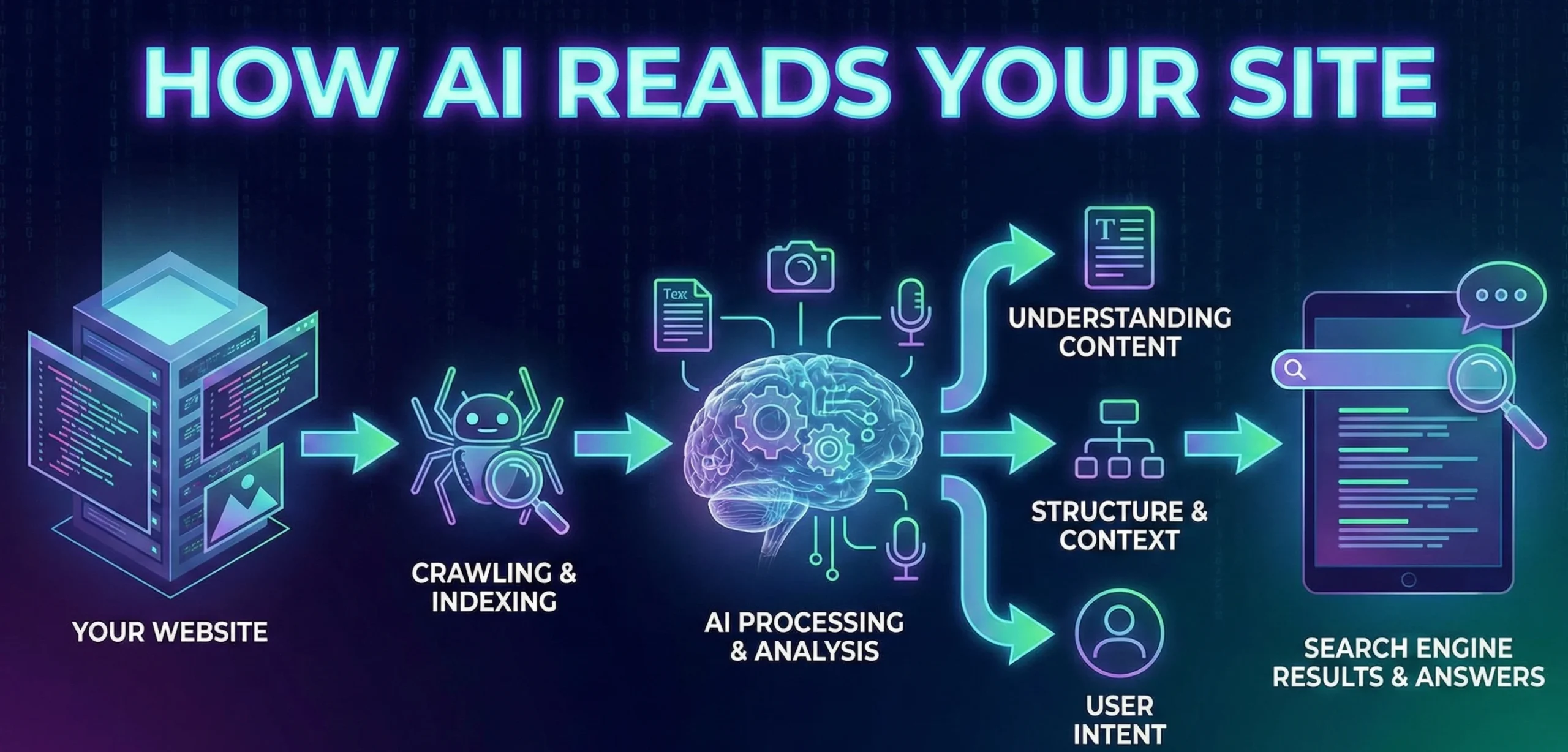
You need to understand how AI engines actually read your website. It’s not magic. It’s mechanics.
AI engines detect entities first. They scan your site for known things: your brand, your products, your services, your location, your team. If you haven’t defined these clearly, the machine doesn’t know what you offer.
They use schema markup to understand meaning. Schema tells AI engines what each piece of content actually is. An article. A product. A service. A review. Without it, the machine has to guess.
They scan your data layer for accuracy. This is the invisible layer most business owners never touch. It holds business information, tracking events, and user interactions. AI engines read this directly to verify your claims.
They check site speed and Core Web Vitals. Slow sites signal poor quality to AI systems. Fast sites get trust.
They score your content clarity. Is it easy to read? Does it make sense? Or is it buried in fluff and keyword padding?
They build vector embeddings to understand context. This is how AI systems figure out that you’re talking about the same topic throughout your site, even when you use different words.
Here’s the simple version: AI checks many signals before showing your content. All of these signals have to be clean and consistent.
The New AI SEO Mindset Business Owners Need
This is where most teams go wrong. They still think like traditional SEO people.
SEO is no longer only about keywords. Yes, keywords matter. But they’re one small piece now.
SEO now means “teach the machine.” Your job is to make your site so clear that an AI system understands your business better than your competitors’ sites.
Your site must be easy for AI to read. Not just fast. Not just mobile-friendly. But technically clean at every layer.
AI search picks sources with clean technical signals. If two sites cover the same topic, the one with better schema, cleaner data, stronger entities, and more consistent metadata wins.
This shift is real. And it’s happening faster than most people realize.
Technical SEO Foundations You Must Fix First
Before you get fancy with AI optimization, get the basics right.
Your site’s speed matters more than ever. AI engines penalize slow sites. Focus on three metrics: Largest Contentful Paint (LCP) – how fast your main content loads. Cumulative Layout Shift (CLS) – whether elements move around when the page loads. Interaction to Next Paint (INP) – how responsive your site feels when users click things.
Mobile usability is non-negotiable. Most AI searches happen on mobile. If your site doesn’t work on phones, you’re already losing.
Clean Up Your Indexing
Broken pages tell AI engines your site isn’t maintained. Remove them or fix them. Duplicate pages confuse AI about which version to show. Thin content (barely 100 words) gets deprioritized.
Submit an XML sitemap so AI crawlers know what matters. Fix your robots.txt file. Make sure you’re not blocking important pages from being indexed.
Improve Your Site Architecture
Clear navigation helps users and machines understand how your content connects. Simple URL structure makes sense to AI systems – no weird parameters or hidden layers.
Create logical content clusters. Group related topics together. Link them internally. Show AI how your content supports each other.
Entity SEO: The Secret to Ranking in AI Search
This is the part that separates winners from everyone else.
AI engines use entities instead of keywords. An entity is just a known thing. Your brand name. Your products. Your service areas. Your team members. Your location.
The more clearly you define these, the better AI understands your relevance.
Here’s the checklist:
Define your brand entity clearly. What are you? Create a “Who We Are” page that leaves no room for confusion. Tell AI exactly what business you’re in.
Define your product or service entities. Don’t just mention them – create content about them. Give them pages. Explain what makes them different.
Add supporting content that reinforces these entities. Write about how your products solve problems. Show expertise. Reference your entities repeatedly (without forcing it).
Use internal links to strengthen entity relationships. When you link from a product page to your brand page, you’re showing AI how things connect.
One company I worked with went from invisible in AI search to showing up in ChatGPT results within 60 days just by cleaning up their entity definitions and internal linking structure. They didn’t create new content. They just made what they had clearer.
Schema Markup: Your New AI Ranking Booster
Structured data is no longer nice-to-have. It’s essential.
AI engines depend on schema to understand what your content means. Without it, you’re asking the machine to guess.
Add these schemas if they apply to your business:
Organization schema (tells AI about your company). Person schema (for team members and authors). Product schema (for items you sell). FAQ schema (for common questions). Service schema (if you offer services). Review schema (for customer testimonials). Article schema (for blog posts). Breadcrumb schema (for navigation paths).
Keep these practices in mind:
Use JSON-LD format. It’s what modern AI engines expect. Keep schema clean and accurate. Don’t add fake data. Match your schema to what’s actually on the page. Don’t claim you have 500 reviews if you only have five. No spam. No tricks.
A quick example: A healthcare provider added schema markup for their services and saw 40% more traffic from AI-powered search results within eight weeks. Why? Because Google AI and ChatGPT suddenly understood exactly what services they offered and matched them to relevant questions.
AI Metadata: The Next-Level Optimization Layer
Most people skip metadata. That’s a mistake.
AI Search uses metadata way beyond what traditional SEO demands. Your title and description matter, sure. But there’s more.
Write clear meta titles that tell AI exactly what the page is about. Not clickbait. Not keyword-stuffed. Just clear.
Write clear meta descriptions that summarize the actual value. AI engines use these heavily to understand your page’s purpose.
Add a short value summary at the top of your page. This is a sentence or two that explains why someone should care. AI loves this.
Use strong topical anchors in your H1 and H2 headings. These tell AI what topics matter most on the page.
Add image alt text with real meaning. Not “image1.jpg.” Actually describe what’s in the image. This helps AI understand visual content.
Include video metadata if you embed videos. Title, description, duration.
Add author profiles with real credentials. If someone’s writing about healthcare, AI wants to know they’re qualified.
Include published and updated dates. Freshness matters to AI engines.
Data Layer Optimization
This one trips up most business owners because they’ve never heard of it.
Your data layer is the invisible code that tracks user behavior and stores business information. It’s where Google Analytics gets data. It’s where AI engines verify facts about your business.
A clean data layer means AI can trust what you’re saying.
Here’s what to include:
Add a global dataLayer object (this is standard in Google Tag Manager). Include your business name, category, location, and main products or services. Track user events like page views, form submissions, and purchases.
Make sure your dataLayer values match your schema and metadata. If your schema says you’re in New York, don’t say Los Angeles in your data layer. Contradictions tank trust.
Why does this matter? AI engines read multiple parts of your site to verify information. If everything aligns – schema, metadata, content, and data layer – you signal authority. If things contradict each other, AI marks you as unreliable.
Real Technical Workflows for AI-Ready SEO
You don’t need to hire an agency to do this. You need workflows.
Weekly Site Health Check
Run Lighthouse (it’s free). Look for speed issues and fix them. Check for broken pages and remove or redirect them. Verify that important pages are indexed.
Monthly Schema Review
Test your schemas with Google’s schema validator. Add missing schemas. Update outdated information.
Content and Entity Update
Refresh your core pages with fresh information. Add new supporting content about your key entities. Strengthen internal linking.
AI Metadata Review
Rewrite weak meta titles. Fix missing meta descriptions. Update alt text on images.
Data Layer Review
Make sure your tracking is working. Verify that business information in your data layer is current and matches your schema.
That’s it. Five workflows. Do these consistently, and you’ll stay ahead of AI Search changes.
AI-Safe Content Checklist
Content still matters. But it has to be clear.
Write with a clear purpose. Don’t bury your main point. Make it obvious in the first paragraph. Use short sentences. AI (and humans) find long, complex sentences harder to parse.
Write for easy reading. Use lists. Use headers. Use white space. Make your content scannable.
Use real examples. Don’t just say “we help businesses grow.” Say “we helped a software company increase their traffic by 120% in four months.”
Cite credible sources. Back up claims with real data. No fluff. No keyword padding. AI detects and penalizes both.
How MUVERA Shapes Your Technical SEO Strategy
Remember MUVERA? It’s the framework that matters most.
Multi-Vector Retrieval via Fixed-Dimensional Encodings is how AI systems understand your content. Think of it as AI checking many signals at once – schema accuracy, entity clarity, internal linking, title consistency, metadata, and data layer quality.
All these signals have to point in the same direction. If they do, your vector embedding (how AI remembers your content) is strong. If they contradict, it’s weak.
This is why technical SEO is now the foundation. You’re not writing for Google’s algorithm anymore. You’re writing for AI to understand.
Your Final Technical SEO Checklist for AI Search
Here’s what you need done:
✓ Fast site (under 2.5 seconds load time)
✓ Clean code (no errors in console)
✓ Correct indexing (right pages indexed, wrong pages blocked)
✓ Strong entities (clear product, service, brand definitions)
✓ Clean schemas (Organization, Product, Service, Article, etc.)
✓ Good metadata (titles, descriptions, alt text)
✓ Fixed data layer (accurate business info, tracked events)
✓ Clear topical authority (related content linked logically)
✓ Updated content (recent publish dates, refreshed info)
✓ AI-friendly alt text (descriptive, meaningful)
✓ Strong internal linking (entities connected, topics supported)
When you have all of these working together, AI Search starts rewarding you. ChatGPT shows your content. Google AI Overviews include your site. Your traffic grows.
The Path Forward: How to Win in AI Search
Here’s the truth: AI Search is not magic. It’s just machines reading signals.
Your website needs clean signals. Technical SEO is the foundation for AI ranking. If the machine understands you, you win.
The teams that move first on this are already seeing results. One e-commerce company we worked with implemented technical SEO services focused on AI-readiness and saw their ChatGPT visibility go from zero to three featured answers in their top 20 searches within 90 days.
Another service-based business cleaned up their schema and entity definitions, and now they rank in ChatGPT for 15 high-intent search queries they weren’t even on traditional Google for.
This isn’t luck. It’s technical precision.
Most websites still aren’t optimized for AI Search. That means there’s massive opportunity right now. The sites that get their technical house in order first will dominate AI-powered results.
You don’t need to overhaul your entire website. You need to prioritize. Start with the checklist. Fix one thing at a time. Measure results.
AI Search is changing how people find information. Being invisible to AI means losing customers to competitors who made the technical shift.
The question isn’t whether AI Search matters. The question is whether you’re going to move now or wait until it’s too late.
Popular Post

How Social Proof and Trust Signals improves Conversion Rate
Social proof and trust signals work. Full stop. Products with just 5 reviews sell 270%...

What Are Common CRO Mistakes (And How to Fix Them)
Right now, your website is probably leaving 20–50% of potential customers on the table. Not...

What Is the 80/20 Rule in SEO?
The 80/20 rule in SEO is simple: 20% of your work drives 80% of your...
